Successful local entrepreneur tells his secrets

“Set goals and never give up.”

This is what Duncan Paul, a highly successful entrepreneur with eight thriving businesses, says are the most important keys to success as an entrepreneur, when he recently spoke of the lessons he’s learnt in business, at a seminar hosted by Sanlam / Business Partners Entrepreneur of the Year® (EOY 2013) in Pietermaritzburg.

Entrepreneurs are essential for our country, said Nimo Naidoo, Business Partners’ assistant general manager and the project manager of the EOY 2013 competition. “An estimated 45% to 50% of South Africa’s GDP [gross domestic product] is contributed by SMEs [small and medium-sized enterprises]”. She said EOY 2013 aims to unlock entrepreneurial talent, and acknowledge entrepreneurs as heroes and role models in our economy.

Paul fits this description of an entrepreneur well. Not only has he achieved impressive business success in less than 20 years, but he has also found time to ski the last degree to the South Pole, has climbed Kilimanjaro three times, scaled in the Himalayas up to 6 200 metres, competed in many Duzi canoe marathons, and became — along with his partner — the first South African to finish the 750-kilometre Yukon Quest canoe race in the Canadian Rockies. He regularly leads safari expeditions to remote corners of Africa as part of his hunting safari company. He says that without the belief and support shown by Business Partners at the beginning of his “great adventure”, he would likely never have made it out the starting gate.

“I had a big vision, which scared the formal banking sector, and I couldn’t raise money anywhere,” he said. “Business Partners have always been in the right place at the right time for me.”

Paul acknowledges he was a “late starter”, who only became an entrepreneur at the age of 38. He first worked as a policeman in the Rhodesian Police Force (and was decorated for gallantry), then worked for the Natal Parks Board and the Natal Sharks Board, after which he went into farming and then game ranching in Zululand (picking up conservation awards along the way) and Bophuthatswana national parks.

While working to commercialise wildlife utilization within Bophuthatswana national parks, he saw how systems and disciplines in a business could pay off, and decided to make a go of it on his own by founding Hunters and Guides with eight other partners. He says that the involvement of Business Partners has brought the same benefits to his businesses today.

“I have learned from them,” he said. “Byron Jacobs [Business Partners’ regional general manager for KwaZulu-Natal] is a mentor to me and has guided and advised me through troubled times.”

Paul admitted that he went through some rough patches though: first with Hunters and Guides, when political issues in central Africa and problems with partners threatened his business, and then with his chain of Spur franchises, when he expanded too quickly and had again ran into partnership problems.

“I’ve earned my professorship in partnerships over the years,” he joked.

One of the crucial things he learnt with Business Partners is the importance of attention to detail.

“We hold monthly meetings that focus on every aspect of business. We go through everything: every expense and income, right down to the annual sick leave for each staff member – for each business.”

He lists this, and setting goals and not deviating from them, as the most important keys to success.

Paul says there are other hard-won lessons he’s learned over the years:

• Follow your passion. “Know what drives you,” he says.

• Be tenacious.

• Believe in yourself and your team.

• Surround yourself with quality staff and mentors.

• Select you partners “very, very carefully. They must share your morals, goals and passion,” he advises.

• Big is not always better.

• Stick to your core business and what you know. “Be careful of going off your beaten path,” he cautions.

• Build bridges and networks. “Don’t be a breaker,” Paul says.

• Live a life of integrity. “Do the right things in everything you do, and doors will open,” he promises.

• But he warns: “Never take anything for granted – things can change.”

-Ends-

ADDITIONAL INFO

At one stage, Duncan Paul was running six Spur franchises, and his Hunters and Guides safari company — a time he describes as characterized by “buffaloes and burgers”.

In 2002, it all began to unravel: first when political problems in the African countries he operated in threatened the Hunters and Guides business, and then when partnership problems in his Spur franchises threatened his very survival in the market.

Paul dealt with the problem decisively: he fired his general manager, sent all his Spur managers on back-to-basics training, and introduced incentives. Within three months, with the help of Business Partners, they had turned it around. Two years later, at the annual Spur Convention, “we swept the board in all award categories,” says Paul.

He subsequently sold four of the Spurs and today has Boulder Creek Spur in Pietermaritzburg’s Liberty Midlands Mall, Kansas Spur at the Pavilion in Westville, two John Dory franchises (at Liberty Midlands Mall and the Golden Horse Casino), Rockafellas restaurant and White Horse function room at the Golden Horse Casino, Dun Adventures safari company, a bed and breakfast establishment, and a property portfolio.

He currently employs over 400 people, and even during the current economic downturn has not made any staff redundant and still pays staff bonuses and increases. He has used the present economic situation to perfect his business model and enhance training for all levels of staff. “We are actually doing better,” he said. “We are operationally more efficient.”

Duncan Paul lives in Pietermaritzburg.

Why entrepreneurial skills are important for a business

This month we chat to Justin Hawes of Scan Display, who was one of the finalists in the EOY 2012 competition about how he manages to instil entrepreneurial skills within his business.

justin-webHow do you develop entrepreneurial skills within your business?

With freedom comes responsibility. Therefore my management style is very much one of making each employee accountable for their actions. I do not meddle in how they get a job done, or what hours they work, but give them the freedom to achieve the results we need in the way they want to. This in turn encourages an entrepreneurial spirit in the company.

This is especially true for our Account Executives. They effectively run their own business within Scan Display: they manage the entire process of quoting, closing sales, project managing each job to completion and following up on payments. To facilitate this, I empower them to make their own decisions, such as which of our solutions to offer clients and choice of supplier. This impacts their earnings, so they are very responsible in how they handle it.

Of course, I need to identify the right kind of personality for this role. I need to have Account Executives who are comfortable with this responsibility. In addition, we also have systems in place that ensure we are delivering a uniformly high quality product to our clients.

Why is the development of entrepreneurial skills so important?

By ensuring Scan’s staff are responsible and empowered, and able to be creative with their solutions, our business is able to run more efficiently. I also believe our staff members enjoy this working environment as they feel stimulated and challenged. But they also always know they can come to me with questions and concerns – my advice and support is always available.

Do you think that because of your focus on these types of skills you have an advantage over competitors?

Yes, without a doubt. Our Account Executives drive our business forward, and they would not be able to drive it so quickly if they were not empowered in this way.

Why should fellow entrepreneurs look to do the same within their business?

If you empower your staff members to act as entrepreneurs, they are more committed to their work. They take ownership of their role and are hungry for success. We reward our Account Executives financially, and they make commission from the first R1 they sell out of every job they do. This keeps them fully invested in the business and its success.

Why is entrepreneurship so important for South Africa?

All the greatest countries in the world have a culture of entrepreneurship, and it stimulates economic growth and development. The United States is a prime example of this, as anyone can start a business venture, and it is easy to move in and out of different businesses. India is also an example of a country in the developing world where people are coming up with creative businesses that bring value to the market and give them an income.

When I was recently there, I had the sense that everyone had a job, from laundry people (“debwashers”) to the people who collect lunch boxes from homes to deliver to their owners at work (“tiffin-carriers”). Everyone is busy doing something, and earning something.

By encouraging entrepreneurship in South Africa we will be able to stimulate job creation. Rather than relying on the government to create jobs, people will be in a position where they can create their own jobs – and ultimately more jobs for other people too.

EOY finalist discusses how seasonality affects her business

Seasonal entrepreneurs rely on the cyclical nature of their business and are therefore required to be considerably future orientated when making managerial decisions. This can be very challenging and requires careful planning and an in depth understanding of one’s business environment.

Anthea Ambursley, General Manager of Anansi Business Enterprises T/A Anansi Heights guest house, is a seasonal entrepreneur and was also a finalist in the 2012 Sanlam / Business Partners Entrepreneur of the Year® competition. As an entrepreneur operating in the local tourism and hospitality sector she is greatly affected by the cyclical nature of her industry, and indicates that 80% of her turnover is generated during seasonal peaks. “It is therefore imperative that we actively take seasonality into account when managing the business.”

She says that the seasonal nature of the hospitality industry has a strong influence in the strategic management of her business. “Operating in a seasonal business cycle requires an efficient model that relies on accuracy and precision. One has to be extremely accurate in calculating monthly overheads, restructuring targets and most importantly, cash flow management.”

Seasonality also affects decisions regarding capital investments, which is not exclusive to human capital. “Employing staff is a very important issue that requires careful consideration. Hiring temporary workers during peak periods is largely preferable in this industry to maximise the favourable peaks in the business cycle, without incurring losses during the troughs, and avoids having to fire permanent staff members.”

However, Ambursley stresses that it also of utmost importance to account for changes in the business cycle that are a direct result of changing economic conditions. “Operating in a seasonal business educates one how to handle fluctuations in the economic climate. It is important to note that good fortunes may be a direct result of a prevailing economic or sector-specific tailwind and that tougher times may potentially lie ahead.”

Photos: 2010 EOY winners

We would like to congratulate those heroes of 2010 who overcame even the challenges of the recession to come out tops and show that nothing is impossible.

One step at a time

EOY winner the embodiment of real entrepreneurship

martin-beyers

Martin Beyers is no Richard Branson; he does not instantly draw you into his world with a wealth of charisma.

Neither is he a Steve Jobs; intent on taking over the world one iPod at a time.

He also does not remind you of Lakshmi Mittal; the creator of a global empire.

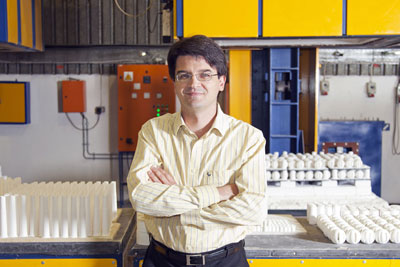
Yet, Beyers beat hundreds of South African business owners to win the 2010 Sanlam / Business Partners Entrepreneur of the Year ®.

The reason for his success in the competition – and in business – is clear within minutes of meeting the man: he is the embodiment of real entrepreneurship.

Vision, creativity, innovation, careful planning, passion and hard work are the best adjectives to use.

 Vision

Beyers studied ceramic technology and worked as a production manager and product developer for a large multinational.

He explains that in the ceramic industry, volumes and standardised products are the name of the game.

“My passion lies in product development and I realised that my interests were not aligned with that of a big firm.”

Because the industry is so specialised, most players know each other and partner Dave Kelly approached Beyers in 2000. Kelly operated as a ceramic reseller but saw the potential a production line offered.

Today, CERadvance is completely focussed on providing its client base with specialised ceramic solutions.

The Jet Park based business is a niche player in a market filled with large conglomerates and Beyers intimately understands the operation’s place in the food chain.

Innovation

Beyers says that the ceramics industry largely focuses on the hardness aspect of their products to add value. But, ceramic is also a material that is extremely heat and corrosion resistant.

“It was only logical to focus on these elements. If you focus on solutions that are commonly available, you need to be volumes driven. This means that it is difficult to focus on niche products where you need to have a lot of interaction with the client. You only have one chance to prove yourself.

“There is space for both approaches in the market but they are extremely different.”

CERadvance acts as a technological partner to its clients where specific solutions are developed using ceramic technology. While this approach might take some time, the eventual solutions offer the client significant cost savings and improved efficiencies in the long run.

Beyers explains that the less often you have to replace a component through wear and tear, the less downtime you have in a production facility. It is this practical cost saving that allows the business to be a niche player in a standardised, volume-driven market.

“You need to understand your product and what it can do. Then, you need to able to look at specific applications. I was lucky in having clients who were hungry for better solutions and who essentially challenged us to come up with products.”

The proof is always in the pudding and CERadvance has managed to double its turnover in the last year to about R15 million.

Beyers explains that the business has grown exponentially in the last number of years as the recession has forced its clients to improve efficiencies.

Planning

For a small, niche player it always difficult to compete against large competitors. Beyers says that from day one, he attempted to provide CERadvance with a professional image that would instil confidence amongst clients.

This included ISO 9001:2000 certification, lecturing at local universities, being visible at seminars and expos and joining industry associations.

He explains that it was extremely important to let the market know that the business was not a fly by night and that their solutions were practical and offered direct value.

“No amount of marketing can beat offering value,” he says with a smile.

CERadvance finds itself in a Catch 22 situation when it comes to product development and capacity. Beyers explains that if a contract is secured, the business needs to be able to deliver immediately. But, this means investing in machinery and infrastructure when the contracts are not yet on the books.

“If you don’t take the risk you will never win. But there is a whole lot of educated guesses behind the decisions.”

This strategy has paid off over the years through continual reinvestment and at the moment, CERadvance’s factory is rapidly becoming too small for its 25 staff members and their production lines.

Hard work

Beyers’ solutions are unique to each client and he explains that you cannot implement a specific solution developed for one scenario in another.

This, to him, would be a dangerous move because he will be unable to completely guarantee the results his clients have come to expect.

But, this reality also means that there are a number of products being developed at any given time. The lead times range from a few weeks to a number of years.

“Some of our products have been in a constant state of development and improvement for six years. The secret is to have a number of products in the pipeline.”

Beyers expects that some products might become standardised as the business moves into a new era but he is quick to add that philosophy has always been “one client, one solution”.

He seems to take the pressure that comes with this business approach quite easily and the secret lies in the enjoyment received through successful product development.

 Self-evaluation

“Creativity is close to everything I do. I think that if an artist does something (remarkable), it is called creativity and if an engineer does something (remarkable) it is called innovation. To me, it is the same thing.

“You don’t have to write a business plan that says: “we will innovate”. It comes to light through the daily operational processes; by finding solutions to problems as they arise…

“There are two parts to innovation. The first is to come up with an idea and the second is to pitch this idea in a way that it defends and sells itself.

“I think there is a shortage of people in South Africa who are able to successfully commercialise their ideas.”

Beyers has learnt to constantly revaluate himself and the business and this was one of the reasons for entering the Sanlam / Business Partners Entrepreneur of the Year ® competition.

He explains that the process allowed people outside of his daily reality – the judges – to enter the operation, identify shortcomings and successes and help him to improve.

“Winning acknowledges that there is a legitimacy to the business, that it adds value and that it is worthwhile. Entrepreneurs want to know that they are on the right path.

“You constantly have to revaluate yourself to ensure that you are on the right path because the small business reality constantly changes.”


The era of entrepreneurial excellence

New Entrepreneur of the Year competition launches

It is easy to call someone a great entrepreneur during the good times. But how do you define a great entrepreneur during the bad times?

Is it the business owner whose business grew during a recession or is it the small business owner that took charge of a difficult situation and applied him or herself to ensure that the business survived?

Entrepreneurship means finding new ways to overcome difficult situations; to find the answers that elude most people.

Entrepreneurship means taking the difficult and usually lonely route outside of a set business environment. You do not have a boss and there is no one who makes the rules for you.

You, as the business’ owner and as an entrepreneur have to decide what will work and what will not. When you make a mistake, there is no one else to blame.

It is these people that Business Partners and Sanlam’s Entrepreneur of the Year award will honour – the self made men and women who have sleepless nights and strive for financial freedom through blood, sweat and tears.

2010 sees a dramatic change to the prestigious Entrepreneur of the Year awards as the competition is opened up to all entrepreneurs in South Africa.

Changes to EOY

The award was initiated in 1989 to give recognition to the vision, innovation, perseverance, drive and commitment of the individuals who run successful small and medium enterprises.

As a private small and medium enterprise (SME) financier, Business Partners, believes it is necessary to place the spotlight on those who are responsible for between 35% and 50% of the nation’s Gross Domestic Product. These business owners not only employ half of the country’s labour force, but also ensure that the economy keeps growing.

In partnership with Sanlam, the competition will now be open to SME decision makers throughout the country.

There are also three new award categories this year an Emerging Entrepreneur (business younger than three years old), a Small Business Entrepreneur (turnover up to R20 million) and a Medium Business Entrepreneur (turnover greater than R20 million) will each be crowned.

The grand title is obviously the Entrepreneur of the Year 2010 and the overall prize is not to be missed: R100 000 in cash, the opportunity to attend an international conference or trade show, as well as extensive exposure in the public domain to get the sales rolling in.

The voice of SMEs

While the prizes on offer are enough to wet any entrepreneur’s appetite, Business Partners and Sanlam’s Entrepreneur of the Year will attempt to make a difference in every SME’s life in the country.

During the course of 2010, the project will host an extensive series of SME-focussed seminars and workshops around the country.

This will culminate in a SME conference in October where SME decision makers will be able to voice their opinion of the operating environment presented in South Africa and the challenges faced.

The seminars, workshops and conference will focus on areas such as financial planning, financial fitness assessment, business opportunities and advice and access to finance. Information on legal developments and changes to the regulatory environment will also be shared with delegates.

Furthermore, Business Partners and Sanlam’s Entrepreneur of the Year project will interact directly with public sector officials to ensure that the SME voice is heard in the highest offices.

Information gathered from SME decision makers regarding the regulatory system in South Africa will be shared with these senior government officials, promoting the development of entrepreneurship and small business development in the country.

Time for change

Business Partners’ Managing Director, Nazeem Martin, explains that the competition is not just about crowning the most inspiring entrepreneur in South Africa, but to develop and foster entrepreneurial development.

“Small and medium sized enterprises are both the fulcrum and the life blood of any country’s economy, contributing between 30% and 50% of GDP, employing more than 60% of our labour force and accounting for more than 65% of new jobs created.

“Celebrating entrepreneurs means we are holding them up as role models – people who create wealth for themselves and jobs for many.

“Hopefully we can increase the incidence of entrepreneurship in South Africa to levels more in keeping with what’s happening in the rest of the world and so improve our country’s ability to compete globally.” Martin says.

Jan Steenkamp, Sanlam Cobalt’s Executive Head, echoes this, saying celebrating entrepreneurs and the entrepreneurial spirit will act as an inspiration to others who have not yet made the leap into the small business environment.

“We also want to ensure that the competition will be a national platform that brings real value to small business owners in their own businesses and the larger operating environment,” he adds.

“Through the competition and its workshops and seminars, we will create a platform for entrepreneurs to interact with their counterparts and be heard nationally. The SME space is often very lonely and the lessons learnt by these business owners over the years need to be shared.”

Steenkamp says it only makes sense that Sanlam and Business Partners, as experts in the SME space, host the flagship competition.

“The media’s spotlight seldom shines on entrepreneurs, especially small business owners. But, it is these SME entrepreneurs who often have to overcome insurmountable obstacles to establish and attain success in their businesses.” Martin says.

“At Business Partners, we believe that entrepreneurs are the true heroes of the South African, and indeed world’s, economic society.”