Fostering creativity through entrepreneurship

A successful entrepreneurial journey begins with a gap in the market, some creativity and passion, and ensuring that you are equipped with the right team and resources. This is according to Nicolette Tilley, owner of Wild and Free (Pty) LTD, and entrant in the 2018 Entrepreneur of the Year® competition sponsored by Sanlam and BUSINESS/PARTNERS, who began her entrepreneurial journey importing wedding dresses and selling them locally on a part-time basis.

This was short-lived, however, as Nicolette soon discovered that selling someone else’s creations was not what she was passionate about.

Being a firm believer in expressing her creativity, Tilley (35) bought a sewing machine during her time as a stay-at-home mom in 2013 and began experimenting with design, making items such as pencil cases and blankets. The entrepreneurial light-bulb moment arrived in 2016 when Tilly was searching for a good quality diaper bag that was durable enough for long-term use. “After fruitless searching, I realised I could design my own bag. I’ve never been afraid to be bold and try to make things work – which is exactly what I did. I found a local leather maker, and together we drew out a pattern and he stitched it together for me. I loved walking around with my own creation on my arm, and before I knew it I had friends asking me to make them bags.”

Before long, bag orders were arriving in their numbers, and with this, Wild & Free was born. “I chose the company name because I wanted it to represent the type of person who would own one of my creations – a free-spirited but driven individual who isn’t afraid of failure,” she says.

Being a self-taught entrepreneur with no formal industry qualifications, Tilley turned to technology and the internet to help her achieve her goals of running a successful business. She strongly encourages self-development as well as using social media to promote and grow a business. “We live in an era where starting your own business is completely achievable, thanks to social media platforms and easy-to-use online business support tools,” says Tilley.  “I often wonder how people advertised and promoted their business before Facebook. There’s a lot of competition out there but we’re fortunate to have knowledge and access to customers at our fingertips,” she adds.

Tilley recalls that one of her biggest challenges since starting the business was keeping up with demand following the launch of one of her bag designs. Within 24 hours of The Business Bags Facebook launch, the product had been viewed online over 1 million times with hundreds of e-mails and orders received. At that point, Tilley was doing all of the marketing, production design and business administration on her own. “I wanted to delete my Facebook page and put my head in the sand – but I knew I had created something that was special, unique and something that women needed. I was fortunate enough to have an old school friend, Josie Piers, jump on board and help me get through the masses of emails and messages. She did a fantastic job of getting processes into place, which was a big weakness of mine. Josie took over all the admin, and today we have a functioning website, one-of-a-kind products and a full team of incredible people in place,” says Tilley.

When asked what her greatest achievement has been thus far, Tilley said that selling over 3000 units of one of her designs is among her biggest achievements on paper but her proudest accomplishment is having created a brand that is able to employ 9 full-time staff members.

When asked what her top tips for other aspiring entrepreneurs would be, Tilley said the following:

  1. There are hundreds of free websites offering short courses. Entrepreneurs starting out who cannot afford to go to university or college should make use of free online tools to educate themselves about their industry.
  2. Set targets for your team and your business before the year begins. This makes your goals a lot more tangible. If you start out knowing what you want to achieve, you will find that you surpass your own expectations.

Past winner catch-up – where are they now?

2018 marks our 30th year in honouring entrepreneurs and the contributions they make toward growing the South African economy. We’re celebrating by catching up with some of the past winners of the competition.

Catching up with: Mpodumo Doubada
Winning year: Innovator of the Year® – 2017

Winning business: Pimp my Book is a successful chain of campus stores across the country, founded on the simple premise of buying and selling used textbooks. After earning his first 10% commission on the sale of his friends’ textbooks, founder, Mpodumo Doubada, quickly saw the opportunity to create a one-stop platform where students could sell their used textbooks for cash, as well as purchase the books they need.

It’s been almost a year since you won the Innovator of the Year title in 2017, how has business been since then?

Over the last few months, business has been very good. We do operate a seasonal business, but even taking this into account, we experienced a bumper season. We have since signed two big clients – bringing in an additional 800 students to our direct market.

The direct spin-off from the EOY competition has also been amazing to watch.  We’ve seen a far more positive reception from various universities and corporates – who have now heard about us through the media and are a little more open to trying our innovative approach.

Have you made any new developments in your business since winning?

At the time of our win, our tech division was relatively new. It has now been rolled out across all our stores and is bringing in more and more business. We have seen a significant increase in laptop sales in the Cape Town area alone. 

Also new, is our new Hatfield store in Pretoria – targeting students of the University of Pretoria and UNISA.

We are also working on an exciting new project for an international market – and we will share more details about this in due course.

On a personal note, I was very fortunate to be selected as a finalist in the 2018 Mandela Washington Fellowship as part of the Young African Leaders Initiative. In June, I will join the other candidates from Sub Saharan Africa as we travel to the United States to learn from our American peers – with the aim to bring leadership skills back to Africa. 

What was the biggest lesson you learned from your stint in the EOY competition?

I’d never seen myself as an “innovator”. Whenever I think of the term, I always think of high tech or new inventions. The competition showed me that in fact, innovation is just about doing things differently. If you change the way something has traditionally been done to solve a problem – then you are an innovator. This was a big eye-opener for me.

One of the toughest things to face during the competition, was the questions posed by the judges. Their questions required a fair amount of self-evaluation. Up until this point, I didn’t recognise the full impact of what we do – until others told me what a great job we were doing. The process really opened my mind to see the changes we make to the communities we serve.

What would your top piece of advice be for anyone looking to enter this year’s competition?

Be authentic about yourself and your business. You need to you know your business and industry inside and out as the judges will interrogate this at a deeper level than you ever have – so you need to be prepared to do the same in preparation.

Above all – let your passion shine through anything you prepare.

Past winner catch-up: where are they now?

2018 marks our 30th year in honouring entrepreneurs and the contributions they make toward growing the South African economy. We’re celebrating by catching up with some of the past winners of the competition.

Catching up with: Elian Wiener

Winning year: Emerging Entrepreneur of the Year® and Innovator of the Year – 2011

Winning business: Epic Communications (now MSL) is an award-winning integrated communications and public relations agency with offices in both Johannesburg and Cape Town. The company specialises in helping businesses build and protect their brands and reputations.

It’s been 7 years since you won the Emerging Entrepreneur of the Year® and Innovator of the Year titles in 2011, how has business been since then?

There have been significant developments for myself and the business since 2011. In the subsequent years, we have continued on our rapid expansion path as we continue to lead the evolution of the communications industry in Africa. Most notably, Epic Communications, which has rebranded as MSL, was acquired by Publicis Groupe in 2014. Publicis Groupe is one of the world’s largest advertising and communications companies in the world. This acquisition has enabled us to bring global best practices to bear for our clients as well as offer a more integrated marketing solution in collaboration with our Publicis owned sister agencies in Africa.

Have you made any new developments in your business since winning?

We have always placed innovation at the forefront of what we do, which has been key in an industry that is rapidly changing. Over the last five years, we have evolved from a traditional public relations agency to an integrated communications agency that seeks to guide our clients through this ever changing marketing landscape. To do this we have completely restructured our business into full service integrated marketing teams and added new offerings in the digital, social media, influencer, reputation management, training and reporting spaces.

What was the biggest lesson you learned from your stint in the EOY competition?

I learned the importance of maintaining a competitive advantage. As a business grows, it naturally loses its start-up advantages – which need to be replaced with others to remain competitive. For us this means constantly reviewing our vision, structure, skill sets, service offering and market positioning. Winning multiple awards at the EOY competition in 2011 also helped to boost our profile and introduce us to a strong network of companies, many of which have gone on to be clients of ours.   

What would your top piece of advice be for anyone looking to enter this year’s competition?

Spend time and effort on your entry. It is crucial to really think about what makes your company special – its vision and the value it adds to all stakeholders.

Past winner catch-up: where are they now?

2018 marks our 30th year in honouring entrepreneurs and the contributions they make toward growing the South African economy. We’re celebrating by catching up with some of the past winners of the competition.

It’s been almost 3 years since you won the Entrepreneur of the Year® title in 2015, how has business been since then?

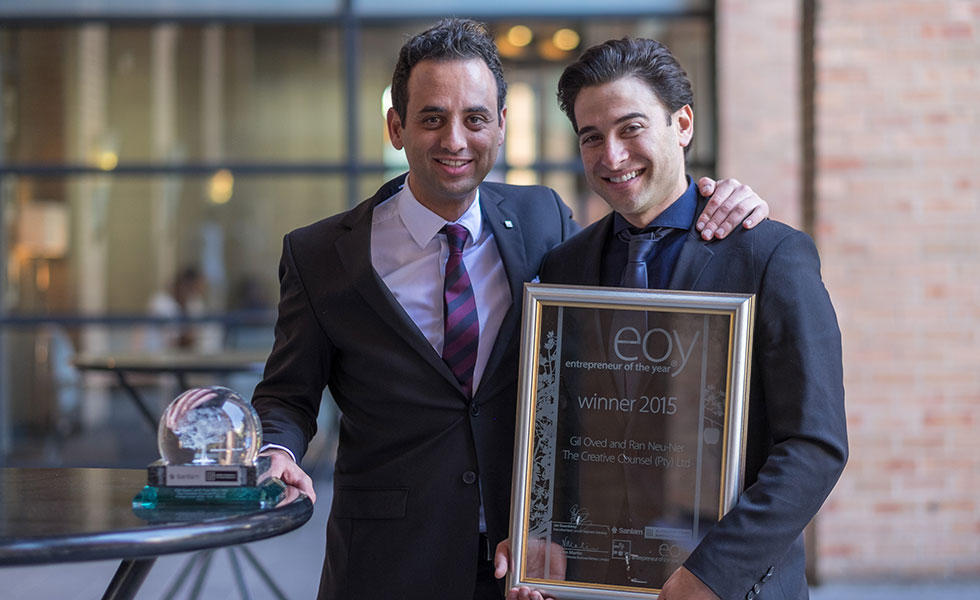
It has been an incredibly interesting time to be in business. It was an amazing coincidence that the Entrepreneur of the Year® awards were announced on the morning of 2 September 2015, and it so happened that later that day, we finalised the sale of our business to the Publicis Groupe – the 3rd largest communications group globally.

We have, however, remained in the business since the sale and we now consult to the business as a whole.

We have also each started different initiatives since then. I am currently working on my 4th start-up – a private equity company called LLH Capital, investing in businesses that are transforming and digitising the African continent.

Have you made any new developments within your business since winning?

The communications industry as a whole has experienced a lot of changes. There have been market entries of new services and technology. To keep up and ensure that we were always able to meet our clients’ needs, we developed OBI – a software programme and system for managing people on the ground. OBI helps businesses to gamify what they do and helps staff track their own performance against that of their peers. We are very proud of OBI, what it does for our staff and in turn, what it can do for our clients.

What was the biggest lesson you learnt from your time in the EOY competition?

Before EOY, we didn’t focus too much on our own brand building or competitions. We thought that people would find out about us if they needed to.  When we entered the competition, we quickly discovered that there was a whole new world waiting for us. Winning was a game-changer and completely shifted our perceptions.

After winning, we received so much recognition and respect from clients, suppliers, and staff. We realised we were actually a force to be reckoned with, not just a small company – something which is very important, but equally something we, as entrepreneurs, tend to struggle with.

The biggest lesson for us was that you need to get your name out there and seek some recognition.

What would your top piece of advice be for anyone looking to enter this year’s competition?

It is important to understand why you deserve the award. Perhaps some advice to this year’s entrants would be to look inwardly and 1) how you contribute to the economy? 2) what you stand for? 3) how have you improved unemployment rate in your community and have you changed people’s lives? 4) how have you contributed to the social fabric of society? What are you proud of?

If you can answer these questions with integrity, then you have a good chance in the competition.

Any last thoughts?

Winning the Entrepreneur of the Year® competition has improved my personal journey as an entrepreneur and definitely our business trajectory. I am still so inspired to do more.

Past winner catch-up – where are they now?

2018 marks our 30th year in honouring entrepreneurs and the contributions they make toward growing the South African economy. We’re celebrating this milestone by catching up with some of the past winners of the competition.

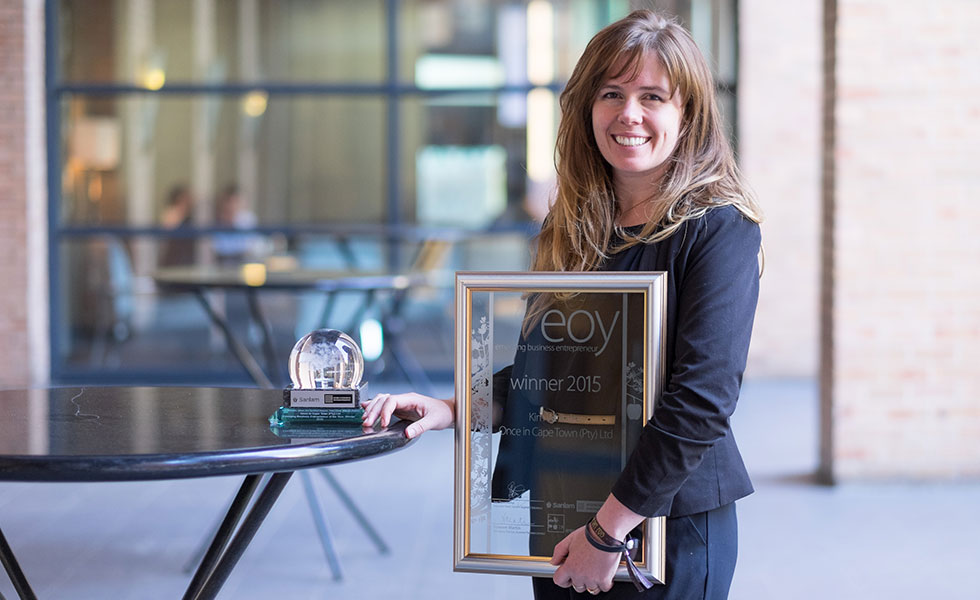
Catching up with: Kim Whitaker

Winning year: Emerging Entrepreneur of the Year® – 2015

Winning business: Once in Cape Town is a combined product of two different accommodation types – a backpackers’ lodge and a luxury hotel – globally dubbed as a ‘poshtel’.

It’s been almost 3 years since you won the Emerging Entrepreneur of the Year® title in 2015, how has business been since then?

Business has been very good – we’ve grown year-on-year and even achieved some goals that we had set out back when we started our journey.

Shortly after winning the title in 2015, we were fortunate enough to realise one of our big dreams – expansion into Gauteng with “Once in Jo’Burg” in 2016. It has been incredibly exciting to watch the new branch grow from strength to strength.

Since the 2015 competition, I also became a parent and being a working-mom has now brought a few new challenges to my life – such as needing to travel and attend business meetings with my child (even to Germany for a trade show!).

Have you made any new developments within your business since winning?

We very recently launched a tourism academy for young women in the tourism industry. The academy will begin in May 2018 with 20 students initially – taking them through the basics of tourism management. We hope this will empower these young women to forge long and successful careers within the local tourism industry.

Eventually we hope to grow the academy to host up to 100 students per year. We want to be a driver of growth in our sector and contribute toward bolstering youth employment in our country.
We were also recently awarded our Fair Trade stamp after a thorough audit – achieving a 100% pass rate which we’re very proud of.

What was the biggest lesson you learnt from your stint in the EOY competition?

The competition was an eye-opener. Bearing witness to the innovative things others are doing reminded me to always put my best foot forward, and to be proud of our achievements.

The entire experience was exceptionally inspirational. I was able to meet and learn from so many like-minded entrepreneurs who have amazing businesses. In turn, this has led me to discover a personal passion for networking with other local entrepreneurs and for investigating the entrepreneurial landscape in South Africa. I am eager to be more involved in helping others discover their entrepreneurial talents and seeing how we, collectively, can grow our country.

What would your top piece of advice be for anyone looking to enter this year’s competition?

I think the biggest, and possibly the most important piece of advice I could offer other entrepreneurs looking to enter the competition would be to be themselves completely. Don’t be something you’re not – you should be proud of your business, and your uniqueness. Be proud to fit outside the box. Most importantly – know your business inside and out – and don’t be shy to show it off.

Opportunities ripe for female entrepreneurs to shatter glass ceiling

The entrepreneurial gender gap is slowly closing in many countries, and in these days, women are as likely as men to start a small business. In hot pursuit of such gender parity is South Africa, where seven women are engaged in early-stage entrepreneurship for every ten male entrepreneurs, according to the recently released 2016/2017 Global Entrepreneurship Monitor.

However, it is imperative for both the public and private sectors in South Africa to band together in order to create an environment where woman entrepreneurs feel well-supported in terms of business growth and development.

We sat down with the female finalists of the 2017 Entrepreneur of the Year® competition who said that although there are highly capable and talented female entrepreneurs in the country, the landscape could still be more conducive. In light of this, they provided insight into how women entrepreneurship can be better supported in South Africa:

Nelisiwe Magubane, chairperson of Matleng Energy, says that the current economic downturn is presenting a number of opportunities and realisations that more women need to be job creators rather than job seekers. However, in order to truly realise this potential and assist female entrepreneurs to flourish, the utilisation of preferential policies as well as the prioritisation of female entrepreneurship should be maximised.

Echoing this sentiment is Refilwe Marumo, director of Mighty Comms, who says that the opportunities for female entrepreneurs in South Africa are slowly improving, thanks to the latest Preferential Procurement Policy which includes the proposed new Preferential Procurement Regulations, an introduction of a compulsory sub-contracting clause stating that a minimum of 30% of the value of all contracts above R 30 million should be undertaken by SMMEs, women, youth, black persons or persons with disabilities.  

“In light of this, the ‘big’ companies in need of subcontractors will be making use of a lot more women owned businesses. However, even with these sorts of measures in place, it really is up to women to market their businesses effectively,” continues Refilwe.

Lindy Scott, Managing & Creative Director of Conceptual Eyes says that although entrepreneurship is seen as high risk to many, in an emerging and dynamic market like South Africa, opportunity is everywhere.  “The market is equally diverse and women should not be scared to work in traditionally male industries; if your service or product adds value – be brave and go for it,” she adds.

“There is no doubt that the number of women entrepreneurs in South Africa is on the rise, despite an unlevelled battle ground,” agrees Ouma Tema founder of Plus-Fab. “South Africa is slowly but surely embracing the new era of women in leadership, and it is imperative for these leaders to be female role models in order for younger women to see the possibility of translating their entrepreneurial aspirations into reality.”

Whilst female entrepreneurship is on the increase in South Africa, it is crucial for these women to speak out against impediments to their development and learn from each other in order to promote entrepreneurship amongst women in South Africa even further.

To get the ball rolling, the finalists provided the following tips for aspiring female entrepreneurs to consider:

  • Maximise networks: This is a great way for entrepreneurs to further extend their knowledge within their field, as well as draw support and inspiration from likeminded individuals. 
  • Learn from mistakes: The path to success will be full of failures, however entrepreneurs should not let this deter them from their goals. Instead, use these failures as lessons and stepping stones to success.
  • Persevere: Although entrepreneurship can be a lonely journey, don’t lose sight of why you started. Remember, that in the end, the reward will be worth the risk.

SME success a by-product of growth

When Pepe Marais and Gareth Leck founded Joe Public in March 1998 in Cape Town, they disrupted the local advertising industry with their innovative business model which was positioned as a Take-Away menu -aimed to demystify the business of advertising by making its service offering transparent to clients.

“We started the business without a cent to our names and grew it through innovation, not only in terms of our business model, but with our creative offering to our clients,” says Marais. “Our unique selling point was that our advertising services for print, TV and radio were categorised as rare, medium and well done and were displayed on a menu,” he explains.

In order to expand their concept, the duo sold their business to IPG, an international marketing network in 2001, and by 2006 had expanded Joe Public to a second office in Johannesburg. It was however not all smooth sailing – it was during 2006 that the business lost its biggest client, resulting in retrenchments due to loss of revenue. “At that stage, we realised that working under the corporate whip of an international giant was counter-productive to our culture and entrepreneurial spirit,” says Marais.

Following this realisation, after three years of negotiations, and amidst a global recession which had detrimental effects on the South African economy, the pair bought back their company and started to rebuild it from the ground up – with depleted cash reserves and a headcount of 30 staff.

“Just as we were getting on our feet again our biggest client slashed their marketing budget to 0%. Because we were trying to rebuild our business, we made the decision to work for free for the next seven months. During this period we also managed to win six new clients,” adds Leck.

To this day, Joe Public is ranked as one of the largest independent, 100% South African owned brand & communications group in the country, offering full services in advertising and communications through five integrated specialist companies: Joe Public (Above-the-line), Connect Joe Public (Digital), Engage Joe Public (Public Relations), Ignite Joe Public (Cross-platform) and Shift Joe Public (Brand Design).

Marais says that through their experience of starting a small business, securing a merger, buying back the company, and then going bankrupt and starting from scratch again, they have developed their management and leadership skills based on their resilient entrepreneurial characteristics.

“Once we regained ownership of our business, it forced us to do some soul searching which resulted in the realisation that the purpose of our business was growth – in terms of bolstering the growth of our clients through advertising, the personal growth of our staff and in turn contributing to the growth of our country,” explains Marais.
“In light of this, we also started our own non-profit organisation in 2008 called One School At A Time and have recently registered our own development academy, Joe Public School of Growth,” continues Marais. “We are passionate about assisting small business owners in growing their businesses and have run 18 workshops to help these individuals define the purpose of their businesses over the past few years.”

Joe Public prides themselves as a people driven organisation and although they are a high energy and competitive meritocracy, they strive to remain courageous, firm, passionate and compassionate at all times.

Pepe Marias and Gareth Leck are finalists in the 2017 Entrepreneur of the Year® competition sponsored by Sanlam and BUSINESS/PARTNERS. For more information on their business, please visit the Joe Public website: joepublic.co.za.

Innovative entrepreneur taking the local ICT sector by storm

100% black female owned company – Mighty Comms – is a broadband solutions company that has carved out a niche for itself in the South African ICT sector. The company offers clients across various sectors broadband and network design services, deployments, installations and maintenance services.

Mighty Comms founder, Refilwe Marumo, says she has encountered many twists and turns during her entrepreneurial journey. “My first business venture was a corporate cleaning business established in 2005 named Mighty Care, which traded for about three or four years. This was followed by a period of broadcasting service applications with a consortium, but after two rounds of applications, we were still not successful and the business had to evolve in order to survive.

“In 2014, we underwent a name change, from Mighty Care to Mighty Comms, and armed with a new vision we focused on the ICT industry, and offered a selection of products that we had experience in. With a staff complement of only four, we started small and the growth has since been organic.”

Today, Mighty Comms employs 10 people, the bulk of which are female technicians and ICT specialists. “We broadened our scope to deployments in 2016, which meant a greater focus on Core Network designs, LAN installations and maintenance, which led to the additional job creation for six technicians. We are passionate about empowering women in the ICT sector and have upskilled all new employees through various courses offered to the ICT industry.

Having recently embarked on machine monitoring innovation with our partner IoT NxT, Marumo says that further employment will be created over the coming year. “Machine monitoring innovation is truly the cutting edge of the Internet of Things (IoT), where analogue equipment is ‘transformed’ into digital, for easier monitoring and asset tracing.

“We believe we are at the crux of the future and in order to scale accordingly, are taking in 20 new learners, who will receive the necessary ICT industry training and exposure. The idea is that some of these learners will be employed by Mighty Comms on a full-time basis in the future,” she explains.

Accredited with global original equipment manufacturers (OEMs) such as Alcatel Lucent, Huawei and Ruckus, and boasting an impressive list of Government and private clients, Mighty Comms seems set for great things. “The business has shown significant growth in the past year, increasing revenue by a whopping 147%,” says Marumo. “We have also been approached by three multinational companies in the past year – one that offers hospital management solutions and another that supplies two-way radio trunking products and a swift messaging platform for the banking sector – to be their local partner.

“These partnerships have led to an even greater focus on the upskilling and training of our employees, as our technicians will need to learn the ropes on how we can take these new products to market,” she concludes.

Refilwe Marumo is a finalist in the 2017 Entrepreneur of the Year® competition sponsored by Sanlam and BUSINESS/PARTNERS. For more information on her business, please visit the Mighty Comms website: mightycomms.co.za.

A business created for students, by students

Mpodumo Doubada – founding CEO of Pimp my Book, a chain of campus stores founded in 2006 at the University of Cape Town (UCT), is a young entrepreneur making waves in the education sector. 31-year-old Doubada from Cape Town founded the business on the premise of buying and selling used textbooks. Since the business was founded, Pimp my Book has expanded to serve a number of universities across the country.

Doubada recounts his own university experience, noting the shared struggle to source textbooks at an affordable price, and how this inspired him to launch Pimp my Book from his dormitory accommodation at the UCT. “I wanted to create a one-stop platform where students could sell their used textbooks for cash as well as purchase the books they need,” says Doubada, recalling his first year of university where he began selling his friends’ textbooks on consignment, taking a 10% commission on all sales made.

Within weeks, his fledgling informal business was flourishing, with students lining up to buy and sell used textbooks. However, the innovation however didn’t stop there. Doubada and his team of now 17 full time staff members, discovered that with increased demand and the setting up of formal stores, a proper, efficient point-of-sale system was required.

The struggle for Pimp my Book however was to find a system which allowed for the buying back of used textbooks, and not only recording the sale thereof. Doubada and his team worked with developers to create their own point-of-sale system unique to their business, which would allow them to track all stages of transactions taking place. “Creating a system that works for our unique business has been one of our greatest achievements, allowing us to expand to multiple stores. I no longer need to manage stock manually, but can monitor stock levels and performance for all stores from the convenience of my office,” he says.

Doubada is proud of his business’ innovation, and credits the success of the business to his team of young, diverse, creative individuals who have all brought their talents to the team. The team is also diverse in terms of experience – with many branch managers having been trained internally from entry level to management. “I look for people who are eager to make something out of their life – I do not train people on the job alone but rather teach them the character and discipline required to make our business work,” he explains.

Having graduated with a Bachelor of Commerce in Accounting as well as a Masters degree in Business Administration (MBA), Doubada has dedicated his entire career to Pimp my Book, and has big dreams to expand his stores into every university in the country. Ultimately, he believes that his business is making a positive contribution to tertiary education in South Africa, pointing to the Fees Must Fall movement which has come about in recent years in the sector. Pimp my Book provides a workable solution to thousands of students who cannot afford brand new textbooks – ultimately helping to ease the burden of the high cost of tertiary education.

Mpodumo Doubada is a finalist in the 2017 Entrepreneur of the Year® competition sponsored by Sanlam and BUSINESS/PARTNERS. For more information on his business, please visit the Pimp my Book website: www.pimpmybook.co.za.   

Independent research firm carves a niche in the investment industry

After having worked as an Investment Analyst for large institutions for 12 years, Shamil Ismail – who was voted the 2014 ABSIP (Association of Black Securities and Investment Professionals) Analyst of the Year – founded Primaresearch in late 2015 as an independent, sell-side, equity research firm based in Cape Town. Since then, Primaresearch has grown to six analysts, and developed a reputation for crafting innovative and insightful research which combines traditional fundamental analysis with industry insights. Primaresearch was voted First in the Innovative Research category of the 2017 Financial Mail Analyst Rankings.

Offering some insight from inside the industry, Ismail explains that the investment sector can be broadly split into two parts – the “buy side” (fund managers) and the “sell side” (stockbrokers). “In recent years, the stockbroking sector has faced multiple challenges, including margin compression, growth in a low-touch, low commission, and more stringent regulations which will ultimately split research and dealing costs.”

Added to these challenges, Ismail says there is growing pressure on South African fund managers to increase their brokerage allocations to black-owned stock broking firms. “So while revenue for the overall brokerage market is under pressure, there is a segment of the market that is growing – the black-owned stockbroker segment.

“There are only a handful of black-owned stock broking firms in South Africa and not all of these brokers have a strong research product offering at present. This is the opportunity that Primaresearch has tapped into: To provide high-quality, niche research by a firm that is owned and majority staffed by black analysts.”

Ismail adds that the business focuses its research on consumer-facing companies. “We have developed a reputation as the ‘go-to’ specialists in the niche of consumer companies and, over the past 18 months, have built a formidable client base which includes all the major asset managers in South Africa, as well as four foreign fund managers.”

In a short space of time, Primaresearch has managed to redefine what sell-side investment research could be. “We have identified a niche, and tapped into the opportunity, with plans in place to grow further in the future. These plans include the launch of ‘PrimaPlatform’, which allows independent analysts to plug into our portal, and service the investment community.”

Shamil Ismail is a finalist in the 2017 Entrepreneur of the Year® competition sponsored by Sanlam and BUSINESS/PARTNERS. For more information on his business, please visit the Primaresearch website: primaresearch.co.za.