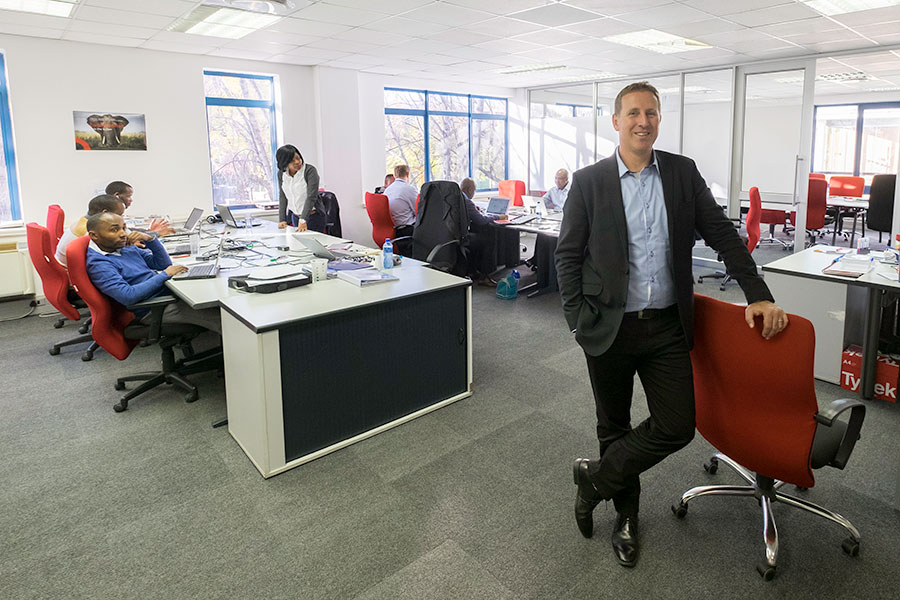
Corporate upskilling entrepreneur awarded Job Creator of the Year

Michael Roberts, owner of Khonology, has been named the 2016 Job Creator of the Year® at theEntrepreneur of the Year® competition sponsored by Sanlam and BUSINESS/PARTNERS awards ceremony held in Johannesburg this morning. Roberts was recognised due to the significant role he is playing in bridging the gap between academia and corporate expectations for graduates entering the workforce.

Founded in early 2013 in response to the skills shortages in South African technology landscape, Khonology is a multi-faceted African services company that provides world-class business solutions with the vision of empowering Africa through the upskilling of local talent and the creation of employment opportunities.

Khonology is carrying out this vision by allocating local talent to projects, which also drives employment throughout the continent. The candidates that are deployed to projects are trained with a particular focus on technological and financial skills which are required within the broader financial services industry.

Although the chosen candidates already have the relevant academic qualifications, these individuals are often not perceived as being attractive to employers, as they do not have the necessary professional experience. Khonology trains and converts this raw talent into competent and hardworking problem solvers for clients, specialising in delivering projects focused on the following streams; data intelligence and reporting, trade/transaction applications, reconciliation, CRM, finance and accounting systems.

With the company having already directly impacted over 120 individuals, with 100 being employed by Khonology over three years, the judging panel was impressed that Khonology has managed to show impressive results in a relatively short period of time. “Michael is clearly onto something unique here, in that he’s recruiting individuals based on their mind sets and qualifications, and refining their professional skills in order to develop more well-rounded employees that can be better marketed to big corporate employers.

“Certain accountants, for example, have all the necessary qualifications, but cannot meet the clients’ needs because they lack practical exposure. This is a situation where a business like Khonology can make a major difference and literally create employment for individuals who may otherwise be seen as ‘unfit’ for the corporate world,” explains the judges.

Roberts believes that this award brings to light the gap between small and big business in terms of the value chain. “Entrepreneurship in South Africa comes with its share of challenges and requires resilience in tough conditions. I believe small and big business need to embrace the notion of working together to explore emerging trends which will in turn help small and medium enterprises to better contribute to the eco-system.

“Winning this award is a multiplication factor for my business in terms of branding and recognition, and speaks volumes about what we trying to achieve by highlighting the successful change that we have managed to bring about thus far,” he concludes.

For more information on Khonology, please visit www.khonology.com.

SA entrepreneurs need your love this Valentine’s Day – they are creating jobs

Are we, as a society, showing enough appreciation to our local entrepreneurs, and expressing just how important they are to kick-starting South Africa’s sluggish economy? This is the questioned raised by Gugu Mjadu, spokesperson for the 2016 Entrepreneur of the Year® competition sponsored by Sanlam and Business Partners Limited.

In light of Valentine’s Day later this week, Mjadu says that South Africans should consider channeling some of their love towards family, friends and associates who have taken the inspiring leap into entrepreneurship. “While entrepreneurs should be acknowledged regularly for their efforts to society, they are often the unsung heroes of a country’s economic development and job creation.”

She points to the recently release Global Entrepreneurship Monitor (GEM) 2015 / 2016 Global Report which revealed that from the 60 economies surveyed in the report, on average, 68% of working-aged adults perceive entrepreneurs to hold a high status in their respective societies and 61% believe they receive positive attention in the media.

Mjadu says that given small and medium enterprises (SMEs) are a major contributor to job creation and economic growth, this percentage should be much higher.

“Societal attitudes indicate how entrepreneurship is regarded in an economy, and can, in turn, impact potential entrepreneurs’ ambitions in the future. This month of ‘love’ (February), as commercial as the day may be, offers the ideal opportunity to celebrate with an entrepreneur you may know, and provide the reassurance and acknowledgment that their hard work and contribution is appreciated and isn’t in vain. By doing this, we are ensuring that those around us, especially future generations, see entrepreneurship as an inspiring and celebrated career option.”

In an efficiency-driven economy such as South Africa, two thirds of working-aged adults perceive entrepreneurship as a good career choice. The 2015/2016 GEM Global report also revealed high societal values about entrepreneurs in South Africa as the country ranked 15th out of 60 economies in terms of the status given to entrepreneurs.

While these figures paint a positive picture, Mjadu says that more needs to be done to express and elevate entrepreneurs’ status in society. “Entrepreneurship in South Africa is still largely driven by necessity, rather than opportunity. We need to celebrate entrepreneurs more often in order to encourage entrepreneurship as a viable career option, rather than a fallback plan. This is one of the core reasons the Entrepreneur of the Year® competition sponsored by Sanlam and Business Partners Limited was launched originally as it serves as a platform to showcase entrepreneurs’ efforts and achievements.”

Mjadu however stresses that society at large can, and should, play a much larger – and daily role – in ensuring that entrepreneurs feel supported while pursuing this tough journey.

“Starting a business venture on your own can be difficult and lonely, but the love and support of those close to you make the challenges more bearable, which could be a determining factor between failure and success. So when you next visit your local supplier, friend, or family member who has started a business, give them a hug and thank them for their hard work and contribution to South Africa’s economy,” concludes Mjadu.

Make your appreciation public! This Valentine’s Day – post a photo on Twitter of you hugging an entrepreneur or proving your entrepreneurial love with the hashtag #HUGanEntrepreneur (@EOY_SA)

KZN nephrology centre awarded top entrepreneurial Judges Prize

Ncamisile Maphumulo, owner of Coastal Nephrology Centre, a kidney dialysis treatment centre in deep-rural KwaZulu-Natal, has been awarded the Judges Prize at the annual Sanlam /Business Partners Entrepreneur of the Year® award ceremony, held in Johannesburg this morning.

The Sanlam / Business Partners Entrepreneur of the Year® Judges Prize, an additional award introduced to the competition last year, was awarded to Maphumulo due to the social impact that her business is making in the community.

The centre was started by Maphumulo when the health company she was working for in the area closed down their dialysis centre, leaving sick patients stranded. Maphumulo decided to start her own business to help the patients who needed to travel hours to receive the necessary treatment, and now provides much needed healthcare solutions in deep rural areas where treatment is not easily accessible.

Feroze Oaten, a member of the 2015 Sanlam / Business Partners Entrepreneur of the Year® judging panel, says that the decision was taken by the judges to award Maphumulo the prize due to the vast difference she is making, as well the entrepreneurial drive that she possess. “She recognised the desperate need in the community and used her competence to render a much needed service.”

Coastal Nephrology Centre offers kidney dialysis treatment services to the population of Ulundi within the Zululand District, a rapidly developing municipality that services a thriving rural community. The business has subsequently branched out, and started a renal unit in Nongoma which began offering treatment in August 2014, Mahlabathini, Melmoth and surrounds.

The centre also offers an education programme which involves a management programme for patients with end stage kidney disease, family history of kidney disease, compromised kidney function, hypertension and diabetes.

Maphumulo says that being recognised by the Sanlam / Business Partners Entrepreneur of the Year® competition means the world to her as it shows that the judges believe in her business and the hard work she has put into it thus far. “Entrepreneurship is all about risk taking and building something from nothing. Entrepreneurs should be celebrated and recognised as they all play a vital role in growing the South African economy and creating jobs.”

For more information please visit www.coastalnephrologycentre.co.za

Quality checks for your business plan

We all know we should check our cars before travelling. Equally important is the need to check your business plan for faults and potential failures before making it the core of your business, or using it to ask for financing. Here is a 6 point check:

1. Can YOU execute?

Failure to convince financiers of this aspect is probably the number one reason for rejection. More critically, it is probably the number one reason for early start-up failure. Points to check: Do you have enough knowledge to run the business? The entrepreneur behind a business which markets services needs to understand marketing, as well as the service. Do you have any experience in this field? Hobbies are often a help in this regard – for instance, enthusiastic cooks setting up catering companies. Do you have the time to execute the planned actions, and will your family support that? Entrepreneurship is not for the faint-hearted – there will be many late nights and early mornings. Can you take risks? If you are uncomfortable with being daring at times you should plan for safer businesses. Can you lead? You will need to tell people what to do and learn to make uncomfortable, even agonising decisions.

2. Have you done a sensibility check?

Most business plans I see have glaring flaws in them. For instance, listing all the grand marketing promotions and advertising planned and then providing a marketing budget of a fraction of that cost. Or not thinking about the capacity of the organisation to handle the projected customers. Are there enough tables in a restaurant to serve the projected number of meals? Can enough sales calls be made to get to the sales forecast? Will the cash flow support the raw material purchases needed? Check the whole plan with a cynical eye.

3. Is there really a reason for customers to buy from you?

Perhaps the second biggest reason for business failure. Take a hard look and answer the question: “Why would this business attract customers away from the companies they now buy from?” If there are insufficient reasons to convince an outsider, then the plan is likely to lead to failure. Think again or find a different business.

4. Are the sales projections realistic?

Entrepreneurs are optimists by nature, but forecasts should always be conservative. Check issues like sales per customer, the proportion of new business to existing customers and the expected win/loss ratio. Cut out the optimism – be realistic or pessimistic. Do not build a plan which is reliant on a marketing promotional plan that has never been tried before.

5. Have the key success factors and major risks been identified?

Your plan should identify the four or five factors that must be achieved for the plan to succeed. Sales running to forecast is usually one of those, but others may be customer satisfaction levels, quality standards, productivity, cash flow or others. These must be monitored frequently, at least once per week, preferably in a dashboard. Risks are equally important. Identify the four or five biggest risks to the success of the plan, have mitigation plans prepared and monitor frequently.

6. Do you know what your competitors are doing?

You must be able to position your company against its competitors with the differences clear in your mind. The test is that you are able to show the customers why they should buy from you, while talking with respect about the competitor.

Now that you have done your safety checks to your car and business plan, you may go away on holiday in a relaxed frame of mind. Enjoy!

This article was written by consultant Ed Hatton. See www.themarketingdirector.co.za for more information. Ed’s business advice blog is at marketingstrategy.co.za

To receive similar articles from Sanlam on a regular basis please click here to subscribe

Perception shift needed among SA youth to create next generation of entrepreneurs

It was recently revealed by a UN agency report that global youth unemployment has risen to near its crisis peak and predicted that it will keep on rising over the next five years. According to Nimo Naidoo of the Sanlam/Business Partners Entrepreneur of the Year® competition, South Africa is in a similar situation and says that the most effective method to counteract this crisis it to create a desirability around entrepreneurship amongst the youth.

Naidoo says that although youth unemployment is a global issue, South Africa’s situation is dire. “According to the recently released Global Entrepreneurship Monitor (GEM) 2012 South Africa report, entrepreneurship does not seem to be a desirable career choice amongst the youth. Approximately 20% of South Africa’s youth population are potential entrepreneurs, and only 15% possess entrepreneurial intensions.”

She says that the rising levels of youth unemployment can be effectively curbed through the promotion of entrepreneurship as a viable career choice for South Africa’s youth. However, it requires a committed change in South Africa’s public perception and culture.

As the youth unemployment rate in South Africa is a very high 48%, Naidoo says that many youth are being driven to entrepreneurship through necessity, which is not necessarily appealing. “Many of today’s youth view informal, survivalist businesses as undesirable, and therefore do not choose to possess entrepreneurial intensions and often find entrepreneurship undesirable.”

She says that by uplifting local entrepreneurial role models, communities will be able build a society that appreciates entrepreneurial activity. “Entrepreneurs which employ a handful of people are effectively assisting to combat the unemployment crisis and should therefore be celebrated.

“A method of instilling a system which celebrates entrepreneurial success could inspire the youth to consider entrepreneurship as a career.”

Naidoo says that according to the GEM report, where perceived opportunities are concerned, South Africa’s rate for perceived opportunities for its youth (39%) is the lowest of the sub-Saharan African countries, as well as substantially below the average of 64%.

She says that the manner in which a country supports and recognises its entrepreneurs determines the culture of entrepreneurship and ultimately moulds the future of the country’s economy. “A positive entrepreneurial culture is not something that can be simply put in place. It begins at the roots of society and needs to be carefully nurtured.

“The level of desirability of entrepreneurship to an individual has an influence on whether or not that person will ultimately pursue an opportunity. Cultural and social norms play significant roles in the lives of individuals and may influence the extent to which an individual perceives entrepreneurship as a desirable option.

According to the Branson Centre of Entrepreneurship’s Young Upstarts 2010 Report, most young people reported not having enough role models to look to or learn from and found it easier to settle for the comfort and predictability of a job, instead of perusing a risky entrepreneurial venture.

Naidoo says that the perception of entrepreneurship amongst the youth in South Africa needs to be raised. “Marketing and strategic platforms, such as entrepreneurial competitions, is a method of doing so, as a great deal of positive exposure is generated around successful entrepreneurs.

“By creating South African entrepreneurial role models out of the Sanlam / Business Partners Entrepreneur of the Year® winners, we are effectively building role models for the youth to imitate,” concludes Naidoo.

Ministry of entrepreneurship necessary in SA

Entrepreneurial leader, Mark Lamberti, recently called for the creation of a Ministry of Entrepreneurship in South Africa at the recent Sanlam / Business Partners Entrepreneur of Year® competition launch. This was echoed by Professor Dilip Garach, of Garach & Garach Financial Advisory Services who called for a Small Business Ministry to be established locally.

According to Nazeem Martin, MD of Business Partners Limited and spokesperson for the 2013 Sanlam / Business Partners Entrepreneur of Year® competition, following President Jacob Zuma’s State of the Nation speech last week, which referenced government programmes that support small business, the formation of an entrepreneurial Ministry would be a significant step forward in tackling SA’s unemployment crisis.

Martin says that he endorses these proposals and says that the efforts that are currently being made to support and grow entrepreneurship do not seem to be effective enough, as South Africa’s ranking in various entrepreneurial reports still seems to be slipping.

According to Professor Garach, it is evident that government understands that small and medium enterprises (SMEs) are an important source of jobs. “Minister Gordhan said in his Budget speech of 2011 that businesses which employ fewer than 50 workers account for 68% of private sector employment. But the government has shown very little commitment towards solving problems that directly impact on experienced entrepreneurs and small businesses.”

He says that South Africa recorded a 7% total early-stage entrepreneurial activity (TEA) level in 2012, which is a 2 percentage point decrease from the 9% recorded in 2011. “While South Africa is better off than it was in 2004 when the TEA level was at 5,4%, the country still has much to work towards.”

Professor Garach says that an entrepreneurial Ministry will be able to focus on reducing the cost of doing business, simplify the current business registration process and SME tax system, create access to finance and create appropriate incentives for South African entrepreneurs.

He says that a step in the right direction may also be government entering into a public / private partnership in order to set up an entrepreneurial academy. “The academy could develop schools that focus on entrepreneurship, as well as provide education in business skills and promote mentorship and training.”

He says that in 1995 Malaysia formed the Ministry of Entrepreneur Development, which clearly demonstrates the importance that the Malaysian government places upon the issue of entrepreneurship and entrepreneurial development. “The Ministry acts as the lead agency for the development of entrepreneurs as well as to co-ordinate entrepreneurship activities in general.”

Among the specific services currently offered by the Ministry are a one-stop entrepreneurship information centre, franchise and vendor development programs, entrepreneurial training, and subsidised business premises for qualified entrepreneurs.

He says that other examples of economies that have implemented this type of body include the US, which has a Small Business Administration Cabinet position which arranges loans, loan guarantees and other assistance to small businesses, as well as Croatia, which has implemented a Ministry of Economy, Labour and Entrepreneurship, which carries out proactive employment policies.

“The SA government target was to create five million jobs by 2020. Although it may not be possible to create this amount of sustainable jobs in the long-term, government however can create an enabling environment to set up one million entrepreneurs who then in turn create five million jobs,” concludes Professor Garach.

2013 EOY competition launches

25 years on and still committed to fostering entrepreneurship in SA

Entrepreneurship is crucial in stimulating a country’s economy, as well as fostering critical skills development and job creation. It is therefore vital that entrepreneurship is embraced and celebrated locally.

Celebrating its 25th anniversary this year, South Africa’s pre-eminent entrepreneurial showcase, the 2013 Sanlam / Business Partners Entrepreneur of the Year® competition has been launched, offering a free platform for the country’s leading entrepreneurs to share their achievements and elevate the profile of their businesses, as well as their profits.

According to Nimo Naidoo, project manager at Sanlam / Business Partners Entrepreneur of the Year®, the competition also provides entrepreneurs with the chance to win prizes worth R 1 340 000, which includes cash prizes to the value of R300 000. “Beyond the chance to win, previous finalists and winners’ businesses have benefitted significantly from the competition’s various networking opportunities and associated marketing and national media exposure,” says Naidoo.

According to 2012 Sanlam / Business Partners Entrepreneur of the Year® overall winner, William Duk of The Plantation Shutter Co., no marketing budget could ever be big enough to purchase the level of exposure that was generated on his behalf. “The award also adds to the level of credibility that a business has in the market place.”

Tabisa Nomnganga of Bravo Promotions, one of the category winners of the 2012 competition, says that winning the Emerging Entrepreneur Award has increased her confidence as an entrepreneur as well as her client base. “Since winning the award in September, I have signed up three lucrative business deals which in total amount to over R500 000. My bottom line profits have also increased by over 40% from the previous financial year.

“In addition, I have had to increase my staff compliment and have thus created more job opportunities within my community.”

Naidoo adds that 2013 entrants will also experience a new streamlined entry and judging process. “This is to primarily ensure that entrants do not become over-burdened during the entry form completion phase and we now expect even greater interest and participation from entrepreneurs from across the country.”

She says that one of the key aims of the competition is to acknowledge successful entrepreneurs in the small and medium enterprise sector and their relentless drive to grow their businesses to keep our economy ticking. “Through this initiative we focus on celebrating entrepreneurship and promote the successes of our heroes in the SME industry.”

According to Naidoo, the competition is open to entrepreneurs from all industries and for businesses of any size. The 2013 competition will also feature a series of national workshops where crucial entrepreneurial skills will be provided to attending business owners.

Entrepreneurs interested in entering can do so here as well as interact with fellow entrepreneurs and entrants on the Sanlam / Business Partners Entrepreneur of the Year® competition social media platforms: twitter: @EOY_SA and Facebook: www.facebook.com/EOY.SA.

The closing date for the competition is 16 June 2013.

Top SA entrepreneur encourages next generation of entrepreneurial leaders

An entrepreneur is not a risk free B-BBEE shareholder, a Tenderpreneur, or the survivalist selling goods along the side of the road to make a living. This is according to Mark Lamberti, well known entrepreneur, Chief Executive Officer of Transaction Capital Limited and founder of Massmart, who was speaking at the recent launch of the 2013 Sanlam / Business Partners Entrepreneur of the Year® competition launch in Johannesburg.

According to Lamberti, an entrepreneur is an individual who sets up a business, taking financial risks in order to make a profit. “Entrepreneurs are innovators who shatter the status quo to set up new products and services. We have many great entrepreneurs in this country who just look at the world through slightly different eyes and create something new and fresh. A very good example of this in South Africa is what Riaan Stassen and Michiel Le Roux have created with Capitec.

“Entrepreneurship has also been described as the pursuit of opportunities beyond the resource’s control. I think that this is always the case. When I wrote the original strategy for Massmart in August 1988 I had a vision of what the business could be, but had no idea where the resources were going to come from to get us there.”

He says that personal characteristics that entrepreneurs often posses is the need for control, independence and achievement. “Entrepreneurial strategy tends to take the form of a niche. Entrepreneurs often don’t go out there and take on the so called ‘big dogs’ head on, they excel in carefully defined markets protected from the existing forces of outright competition. “It may actually be advantageous if others consider the industry in which you are playing as risky, as there will be less players interested in getting involved.”

Lamberti says that entrepreneurs face many challenges on their journeys that need to be overcome in order to grow and develop. “Sometimes entrepreneurs make the mistake of placing too much dependence on a few key people, instead of developing all employees. This limits the growth of the business and developing human capital should be a focus area for local business leaders.”

He says that systems and controls are capabilities that can assist entrepreneurs in overcoming the challenges of growth. “Although these systems and controls can lead to frustrations for business owners, we have to realise that they are absolutely necessary as losing control is not an option. Even wild ducks fly in formation.

“Although education isn’t everything, entrepreneurs should try be as educated as much as possible before starting something. Study books and learn lessons from other entrepreneurs, as these lessons will be very useful when building your business. Any knowledge of financial systems and budgeting will also be very useful.”

Lamberti says that many think that entrepreneurs are extremely risky. “Entrepreneurs are often not the huge risk takers that people perceive them to be. For the most part, entrepreneurs are fanatical about the downside, and are therefore very careful about the risks they take.”

He says that entrepreneurs need to be very careful when it comes to reputation management. “It takes a lifetime to develop a reputation, and only takes a minute to lose it. Entrepreneurs often do not realise how much reputation means until the time comes for them to use it. It is an asset that is very valuable when you need it.

According to Lamberti, entrepreneurs need to realise that experience always serves them best in the long run. “Whenever I was offered choices in my career, I always took the path of more learning rather than the one that would provide more money or power.

“Entrepreneurs also shouldn’t listen to people who say that say that your personal life needs to be sacrificed for entrepreneurial success. The most valuable things in life cannot be measured and they cannot be bought,” concludes Lamberti.

Entrepreneurship challenges

The failure rate of start-ups is exceptionally high – why do these businesses fail?

It is a known fact that the main reason for business failures is management related. It is often intelligent, honest, hard working people that fail. They either do not have the typical entrepreneurial traits required to make a success, or they lack the relevant experience.

I believe that inadequate exposure to that particular business offers the explanation. A successful professional that has been exposed to a corporate environment may find it difficult to understand the typical “tricks of the trade”. The HOW of the business. Without the exposure it can be unfair on the entrepreneur to make a success. After all you need time to learn.

What in your opinion are the dangers in running a business?

There are many dangers that one can list, but I want to address five most prominent:

  1. The first danger is the entrepreneur themselves. Because they have been successful, they start relaxing and complacency replaces that initial enthusiasm, self-drive and sharpness. They do not focus on the important issues as they did years ago and they accept many things as a given, rather than investigating first.
  2. The entrepreneur spends less and less time at the business and allows others to run the business. Can anyone else be as passionate about the business and the success of the business as the entrepreneur? They may prefer to while away time elsewhere, whether it is overseas visits, excessive hours on the golf course and spend business time on, albeit well deserved, community projects.
  3. Poor cash flow management. Many profitable businesses fail because of a lack of sufficient cash flow. It is a vicious circle. As soon as the business is cash strapped, the focus of the entrepreneur changes. Instead of spending time making money, they spend time collecting debts, making arrangements with the creditors and negotiating extended facilities. It becomes survival mode which is not good for business success.
  4. Marketing. The market and behaviour patterns change continuously. It is for the entrepreneur to stay in touch with the latest trends and tendencies. What worked some time ago does not necessarily apply today. Marketing techniques are also dynamic and not to market is to die a slow death. Marketing obviously involves much more than just advertising.
  5. Costing. This applies in particular to manufacturing concerns. The entrepreneur (or someone else) will perform a costing exercise and use these values for a long period of time. If it is not reviewed and re-evaluated as and when the price of material or labour changes, then costing becomes ineffective and irrelevant, and makes the setting of selling prices an impossible task.

Entrepreneurship could cure SA’s growing youth unemployment crisis

Youth unemployment in South Africa has reached boiling point and has spurred on heated political debates and mass protests ending in violence. Governments around the world have tried to react to the mass youth protests and the swelling problem by implementing labour market policies, such as subsidised wages, tax incentives and encouraging school-work transition through apprenticeships and training programs. However, the unemployment figures have continued to soar and have not shown signs of slowing down.

According to Nimo Naidoo of the Sanlam/Business Partners Entrepreneur of the Year® competition, the rising levels of youth unemployment can be effectively curbed through the promotion of entrepreneurship as a viable career choice for South Africa’s youth. However, it requires a committed change in South Africa’s public perception and culture.

She says that the UN estimated last year that 74.8 million young people, between the ages 15 and 24, remained unemployed worldwide, while 6.4 million youths dropped out of the labour force globally. According to an International Labour Organisation (ILO) report, the youth of today are three times more likely be unemployed in comparison to adults, while 1 in 5 young working people live on R8/day.

Naidoo says that recent statistics, released by the latest Labour Force Survey, paints a dire picture for South Africa’s youth. “Youth unemployment has increased by 9.9% since last quarter and is now standing at a staggering 42%. Government has tried to absorb the high unemployment numbers through various state programs and have been actively promoting entrepreneurship in the hopes of reaching their goal of 5 million jobs created by 2020. However, according to Adcorp, a large discrepancy exists in the formal employment market. 800 000 vacancies are available in the private sector, yet 600 000 university graduates remain unemployed.”

“The 2011 South African GEM report, released last week, has also revealed a significant decline in entrepreneurial levels among South Africa’s youth. Entrepreneurship levels of people aged between 18 and 34 have declined significantly by 16% between 2010 and 2011. Evidence, from the recent released GEM report, shows that young entrepreneurs in South Africa chose self-employment out of necessity rather than being motivated by attractive opportunities.”

Naidoo says that these statistics are very worrying and show signs of an unhealthy entrepreneurial culture in South Africa. “The manner in which a country supports and recognises their entrepreneurs determines the culture of entrepreneurship and ultimately moulds the future of the economy. A positive entrepreneurial culture is not something that can be simply put in place. It begins at the roots of society and needs to be carefully nurtured.

Naidoo believes that the roots to South Africa’s entrepreneurial problem can be linked to South Africa’s educational structures. “Both South Africa’s formal and informal educational structures do not prepare the youth to become skilled entrepreneurs. Not only has the structure ill-equipped the youth to become entrepreneurs, but it has created a culture where young South African’s dream of becoming employee’s rather than employers.”

He says that not all individuals posses the qualities to become an entrepreneur and therefore these qualities and talents need to be developed accordingly. “Youth should be exposed to entrepreneurship via the South African education system, as well as leaders and managers of businesses where they work.”

As the business world continues to rapidly evolve an increasing amount of young entrepreneurs, such as Facebook’s Marc Zuckerberg, are emerging as successful entrepreneurs and outright market leaders in their respective industries. Sanlam and Business Partners, the competition’s co-sponsors, would like to recognise the ability and deserved success of South Africa’s young entrepreneurs by encouraging them to enter the 2012 Sanlam/Business Partners Entrepreneur of the Year® competition, which boasts an array of advantages for both finalists and winners.