What can you do to be more professional in business?

It is my experience as a consumer and sample of one, that the level of professionalism in business is on the decline. The question, therefore, is what it means to be professional in our businesses and what can we do to improve our level of professionalism.

www.yourdictionary.com defines “professional” as “… performing a job to high standards…”

So what are “high standards”? This statement does not quantify the standard, but it does state that it should comply with an above average standard. Let`s look at ways in which we can work on and possibly improve the levels of professionalism in our businesses. Are you able to tick off the statements and answer the questions that follow?

Knowledge

Is the level of knowledge of our product and/or service top notch; i.e. can we advise and answer the questions of our clients? If not, we should consider training and improving the skills of ourselves and our staff.

Attitude

Do we have a “can do” and positive attitude towards our clients? The whole sentiment in a business can change if clients sense a positive energy. Friendly and helpful staff will leave a lasting positive impression of our business on clients.

Respectfulness

We should always be mindful that clients pay the bills. This implies, inter alia, that we should be courteous to clients, mind our language and treat them in a respectful manner.

Value

Are our clients receiving more value from us compared to their expectations? This does not necessarily mean that we need to give them “freebies”, but it does imply that we go the extra mile to satisfy their needs and resolve their challenges by offering them the most suitable product and/or service.

Correspondence

Well-written e-mail and other correspondence (grammar and spelling), that also include our logo/branding and contact details, will go a long way towards making us stand out from our competitors. When last did we review our client-directed and internal correspondence?

Marketing elements

We all have websites, brochures and other client-directed collateral. Does the material present a professional look and feel and, as important, does it clearly state our contact details and website address?

Physical appearances

Do our offices or premises show clients that we have respect for our business and them? Is the branding on our premises and vehicles done professionally or has the sun eroded its appearance? Is our Reception welcoming, neat and clean? Are our vehicles clean? Does our dress code and personal appearances show people that we are professional?

Service

Do we answer our phones within a couple of rings? Is our POS (point of sale) staff courteous, friendly and service orientated? How do we treat clients when after-sales service is required? Are we living up to our promises? All these small events are touch points with our clients and add up to their collective experience of our business.

This is by no means a complete list of elements which we can consider to improve our level of professionalism. Maybe the most important measure is our own expectation – if I was a client of my business, would I be satisfied with the level of professionalism I experience? If not, you have your answer.

To support business owners with the important task of business planning, Sanlam gives you free access to the book Your Annual Business Game Plan for Success, which provides an easy and straightforward framework needed to draft a well-crafted game plan that will create the positive change and growth necessary for business success.

Go to www.sanlamgameplan.co.za to download your free copy.

Continuous improvement in business

Kaizen, a Japanese word and philosophy meaning “change for better”, reminds us that incremental and continuous improvement in life and business can and will propel us forward. This philosophy is powerful, because the implementation thereof is all inclusive, from the business owner(s) to the most junior employee.

The question is straightforward – which small improvements can we (on all levels in the business) identify which can be implemented immediately (meaning on the same day or as soon as possible, with little effort and other resources) which will improve the effectiveness and efficiency of our business operations?

Further investigation on how kaizen is applied in business led me to the so called “continuous quality improvement with the PDCA process”:
P = Plan: Plan business operations, e.g. a manufacturing, packaging, marketing, distribution, sales and client support/after service process – this plan sets the current standard of the work.
D = Do: Implement each plan.
C = Check: Inspect each element for quality assurance. When an error or deficiency occurs, we need to highlight it and move onto the next step = Act.
A – Act: Correct/Improve the error or deficiency and incorporate it into the plan. A new baseline for the plan is vested, which should now be an improvement of the previous version.

By repeating this iterative process we have embarked on a continuous journey of improvement.
There is obviously much more to be learned on the philosophy and implementation of kaizen in a business. By teaching our staff and management this very simple PDCA process, we are gearing our business up for continuous improvement, something which can propel us beyond our competitors and surprise our customers with every interaction they have with our business.

Let us focus our effort on the things we can influence and control and thereby grow our businesses in a very challenging business environment.

To support business owners with the important task of business planning, Sanlam gives you free access to the book Your Annual Business Game Plan for Success, which provides an easy and straightforward framework needed to draft a well-crafted game plan that will create the positive change and growth necessary for business success. Go to www.sanlamgameplan.co.za to download your free copy.

SA’s premier entrepreneurial competition marks 30 years of celebrating entrepreneurial excellence

Amid the current political optimism, entrepreneurs should be especially inspired by the continued commitment to SME support which emerged as a consistent theme in both the 2018 State of the Nation Address and the National Budget Speech. This is according to Christo Botes, spokesperson for the 2018 Entrepreneur of the Year® competition sponsored by Sanlam and BUSINESS/PARTNERS, who believes that this continued focus evidences Government’s recognition of the vital role played by entrepreneurs in enabling economic growth.

Speaking in light of the launch of the 2018 competition, Botes says that this long-deserved recognition of the SME sector only further validates the competition’s unwavering commitment to celebrating excellence in entrepreneurship and fostering future economic growth.

“Now in our 30th year, this renowned competition continues to pay homage to the fearless South African entrepreneurs who dedicate themselves to their enterprises and businesses: driving growth, combatting unemployment and contributing towards the country’s economic development. It is therefore wonderful to see the public sector taking the required steps to improving the environment in which these entrepreneurs operate in order to promote further growth in the sector.”

Botes, who is also executive director at Business Partners Limited (BUSINESS/PARTNERS) has been involved in the competition since its inception in 1988, “Looking back over the last 30 years, this competition has evolved from an internal competition that recognized BUSINESS/PARTNERS’ clients only, to a nation-wide search for outstanding South African-based entrepreneurs, with Sanlam as our valued partner.”

He says that the competition continues to reward successful local business owners for the valuable contributions they make to grow their local communities and economies, and aims to inspire others to do the same. “As our 30th- anniversary year, we’re hoping to see even more entrepreneurs enter. The competition is open to all South African-based businesses and prizes are awarded for the following categories: Overall Entrepreneur of the Year®, Emerging Business Entrepreneur of the Year®, Small Business Entrepreneur of the Year®, Medium Business Entrepreneur of the Year®, Job Creator of the Year and Innovator of the Year,” says Botes.

Botes adds that this year, the 2018 competition will also recognize a South African entrepreneur for a Lifetime Achievement award. “The purpose of this specially nominated award is to recognize an entrepreneur who has made a significant contribution to the South Africa economy and has grown their business from start-up to large-scale, perhaps even multi-national corporation. We want to reward the individuals who have dedicated their lives to building our economy and inspiring others to do the same.”

The 2018 Entrepreneur of the Year® competition, sponsored by Sanlam and BUSINESS/PARTNERS, offers prizes valued at over R 2 million, which includes cash prizes of R 70 000 for each main category winner, and R200 000 for the overall winner. Competition winners will also receive valuable mentorship support, networking opportunities and national media exposure.

Botes says that in celebrating 30 years of searching for entrepreneurial talent in all sectors of the economy, the competition remains fiercely committed to its cause in 2018. “The judges are looking for entrepreneurs that have succeeded against the odds, either by carving out a niche market for their product or service offering, or by succeeding in a very competitive environment. Perseverance and endurance, innovation and agility are some of the qualities we look for in the entrepreneur.”

He adds that there are also a number of quantitative competition measures, such as turnover growth, profitability, owners’ equity growth, positive cash flows and job creation that play a part in the competition’s judging process.

To enter, complete the entry form online at www.eoy.co.za and feel free to interact with fellow entrepreneurs, past winners and entrants on our social media platforms www.twitter.com/@EOY_SA and www.facebook.com/EOY.SA. The closing date for the competition is 31 May 2018.

SA’s premier entrepreneurial competition marks 30 years of celebrating entrepreneurial excellence in Durban

Amid the current political optimism, entrepreneurs should be especially inspired by the continued commitment to SME support which emerged as a consistent theme in both the 2018 State of the Nation Address and the National Budget Speech. This is according to Kobus Engelbrecht, spokesperson for the 2018 Entrepreneur of the Year® competition sponsored by Sanlam and BUSINESS/PARTNERS, who believes that this continued focus evidences Government’s recognition of the vital role played by entrepreneurs in enabling economic growth.

Speaking in light of the launch of the 2018 competition in Cape Town today, Engelbrecht says that this long-deserved recognition of the SME sector only further validates the competition’s unwavering commitment to celebrating excellence in entrepreneurship and fostering future economic growth.

“Now in our 30th year, this renowned competition continues to pay homage to the fearless South African entrepreneurs who dedicate themselves to their enterprises and businesses: driving growth, combatting unemployment and contributing towards the country’s economic development. It is therefore wonderful to see the public sector taking the required steps to improving the environment in which these entrepreneurs operate in order to promote further growth in the sector.”

Christo Botes, executive director at Business Partners Limited (BUSINESS/PARTNERS) has been involved in the competition since its inception in 1988, “Looking back over the last 30 years, this competition has evolved from an internal competition that recognized BUSINESS/PARTNERS’ clients only, to a nation-wide search for outstanding South African-based entrepreneurs, with Sanlam as our valued partner.”

He says that the competition continues to reward successful local business owners for the valuable contributions they make to grow their local communities and economies, and aims to inspire others to do the same. “As our 30th- anniversary year, we’re hoping to see even more entrepreneurs enter. The competition is open to all South African-based businesses and prizes are awarded for the following categories: Overall Entrepreneur of the Year®, Emerging Business Entrepreneur of the Year®, Small Business Entrepreneur of the Year®, Medium Business Entrepreneur of the Year®, Job Creator of the Year and Innovator of the Year,” says Botes.

Engelbrecht adds that this year, the 2018 competition will also recognize a South African entrepreneur for a Lifetime Achievement award. “The purpose of this specially nominated award is to recognize an entrepreneur who has made a significant contribution to the South Africa economy and has grown their business from start-up to large-scale, perhaps even multi-national corporation. We want to reward the individuals who have dedicated their lives to building our economy and inspiring others to do the same.”

The 2018 Entrepreneur of the Year® competition, sponsored by Sanlam and BUSINESS/PARTNERS, offers prizes valued at over R 2 million, which includes cash prizes of R 70 000 for each main category winner, and R200 000 for the overall winner. Competition winners will also receive valuable mentorship support, networking opportunities and national media exposure.

Engelbrecht says that in celebrating 30 years of searching for entrepreneurial talent in all sectors of the economy, the competition remains fiercely committed to its cause in 2018. “The judges are looking for entrepreneurs that have succeeded against the odds, either by carving out a niche market for their product or service offering, or by succeeding in a very competitive environment. Perseverance and endurance, innovation and agility are some of the qualities we look for in the entrepreneur.”

Engelbrecht adds that there are also a number of quantitative competition measures, such as turnover growth, profitability, owners’ equity growth, positive cash flows and job creation that play a part in the competition’s judging process.

Entrepreneurs are encouraged to enter the competition and can do so by downloading the entry form online at www.eoy.co.za. They can also interact with fellow entrepreneurs, past winners and entrants on the competition’s social media platforms www.twitter.com/@EOY_SA and www.facebook.com/EOY.SA. The closing date for the competition is 31 May 2018.

SA’s premier entrepreneurial competition marks 30 years of celebrating entrepreneurial excellence in Cape Town

Amid the current political optimism, entrepreneurs should be especially inspired by the continued commitment to SME support which emerged as a consistent theme in both the 2018 State of the Nation Address and the National Budget Speech. This is according to Kobus Engelbrecht, spokesperson for the 2018 Entrepreneur of the Year® competition sponsored by Sanlam and BUSINESS/PARTNERS, who believes that this continued focus evidences Government’s recognition of the vital role played by entrepreneurs in enabling economic growth.

Speaking in light of the launch of the 2018 competition in Cape Town today, Engelbrecht says that this long-deserved recognition of the SME sector only further validates the competition’s unwavering commitment to celebrating excellence in entrepreneurship and fostering future economic growth.

“Now in our 30th year, this renowned competition continues to pay homage to the fearless South African entrepreneurs who dedicate themselves to their enterprises and businesses: driving growth, combatting unemployment and contributing towards the country’s economic development. It is therefore wonderful to see the public sector taking the required steps to improving the environment in which these entrepreneurs operate in order to promote further growth in the sector.”

Christo Botes, executive director at Business Partners Limited (BUSINESS/PARTNERS) has been involved in the competition since its inception in 1988, “Looking back over the last 30 years, this competition has evolved from an internal competition that recognized BUSINESS/PARTNERS’ clients only, to a nation-wide search for outstanding South African-based entrepreneurs, with Sanlam as our valued partner.”

He says that the competition continues to reward successful local business owners for the valuable contributions they make to grow their local communities and economies, and aims to inspire others to do the same. “As our 30th- anniversary year, we’re hoping to see even more entrepreneurs enter. The competition is open to all South African-based businesses and prizes are awarded for the following categories: Overall Entrepreneur of the Year®, Emerging Business Entrepreneur of the Year®, Small Business Entrepreneur of the Year®, Medium Business Entrepreneur of the Year®, Job Creator of the Year and Innovator of the Year,” says Botes.

Engelbrecht adds that this year, the 2018 competition will also recognize a South African entrepreneur for a Lifetime Achievement award. “The purpose of this specially nominated award is to recognize an entrepreneur who has made a significant contribution to the South Africa economy and has grown their business from start-up to large-scale, perhaps even multi-national corporation. We want to reward the individuals who have dedicated their lives to building our economy and inspiring others to do the same.”

The 2018 Entrepreneur of the Year® competition, sponsored by Sanlam and BUSINESS/PARTNERS, offers prizes valued at over R 2 million, which includes cash prizes of R 70 000 for each main category winner, and R200 000 for the overall winner. Competition winners will also receive valuable mentorship support, networking opportunities and national media exposure.

Engelbrecht says that in celebrating 30 years of searching for entrepreneurial talent in all sectors of the economy, the competition remains fiercely committed to its cause in 2018. “The judges are looking for entrepreneurs that have succeeded against the odds, either by carving out a niche market for their product or service offering, or by succeeding in a very competitive environment. Perseverance and endurance, innovation and agility are some of the qualities we look for in the entrepreneur.”

Engelbrecht adds that there are also a number of quantitative competition measures, such as turnover growth, profitability, owners’ equity growth, positive cash flows and job creation that play a part in the competition’s judging process.

Entrepreneurs are encouraged to enter the competition and can do so by downloading the entry form online at www.eoy.co.za. They can also interact with fellow entrepreneurs, past winners and entrants on the competition’s social media platforms www.twitter.com/@EOY_SA and www.facebook.com/EOY.SA. The closing date for the competition is 31 May 2018. 

SA’s premier entrepreneurial competition marks 30 years of celebrating entrepreneurial excellence in Johannesburg

Amid the current political optimism, entrepreneurs should be especially inspired by the continued commitment to SME support which emerged as a consistent theme in both the 2018 State of the Nation Address and the National Budget Speech. This is according to Christo Botes, spokesperson for the 2018 Entrepreneur of the Year® competition sponsored by Sanlam and BUSINESS/PARTNERS, who believes that this continued focus evidences Government’s recognition of the vital role played by entrepreneurs in enabling economic growth.

Speaking in light of the launch of the 2018 competition in Johannesburg today, Botes says that this long-deserved recognition of the SME sector only further validates the competition’s unwavering commitment to celebrating excellence in entrepreneurship and fostering future economic growth.

“Now in our 30th year, this renowned competition continues to pay homage to the fearless South African entrepreneurs who dedicate themselves to their enterprises and businesses: driving growth, combatting unemployment and contributing towards the country’s economic development. It is therefore wonderful to see the public sector taking the required steps to improving the environment in which these entrepreneurs operate in order to promote further growth in the sector.”

Botes, who is also executive director at Business Partners Limited (BUSINESS/PARTNERS) has been involved in the competition since its inception in 1988, “Looking back over the last 30 years, this competition has evolved from an internal competition that recognized BUSINESS/PARTNERS’ clients only, to a nation-wide search for outstanding South African-based entrepreneurs, with Sanlam as our valued partner.”

He says that the competition continues to reward successful local business owners for the valuable contributions they make to grow their local communities and economies, and aims to inspire others to do the same. “As our 30th- anniversary year, we’re hoping to see even more entrepreneurs enter. The competition is open to all South African-based businesses and prizes are awarded for the following categories: Overall Entrepreneur of the Year®, Emerging Business Entrepreneur of the Year®, Small Business Entrepreneur of the Year®, Medium Business Entrepreneur of the Year®, Job Creator of the Year and Innovator of the Year,” says Botes.

Botes adds that this year, the 2018 competition will also recognize a South African entrepreneur for a Lifetime Achievement award. “The purpose of this specially nominated award is to recognize an entrepreneur who has made a significant contribution to the South Africa economy and has grown their business from start-up to large-scale, perhaps even multi-national corporation. We want to reward the individuals who have dedicated their lives to building our economy and inspiring others to do the same.”

The 2018 Entrepreneur of the Year® competition, sponsored by Sanlam and BUSINESS/PARTNERS, offers prizes valued at over R 2 million, which includes cash prizes of R 70 000 for each main category winner, and R200 000 for the overall winner. Competition winners will also receive valuable mentorship support, networking opportunities and national media exposure.

Botes says that in celebrating 30 years of searching for entrepreneurial talent in all sectors of the economy, the competition remains fiercely committed to its cause in 2018. “The judges are looking for entrepreneurs that have succeeded against the odds, either by carving out a niche market for their product or service offering, or by succeeding in a very competitive environment. Perseverance and endurance, innovation and agility are some of the qualities we look for in the entrepreneur.”

Botes adds that there are also a number of quantitative competition measures, such as turnover growth, profitability, owners’ equity growth, positive cash flows and job creation that play a part in the competition’s judging process.

Entrepreneurs are encouraged to enter the competition and can do so by downloading the entry form online at www.eoy.co.za. They can also interact with fellow entrepreneurs, past winners and entrants on the competition’s social media platforms www.twitter.com/@EOY_SA and www.facebook.com/EOY.SA. The closing date for the competition is 31 May 2018. 

How to raise profit margins without losing customers

The beginning of the year is the ideal time for small and medium enterprise (SME) owners to explore additional revenue streams and other means of increasing their profit margins. However, this process is expected to still present some challenges for SME owners owing to South Africa’s economic environment, which while showing some slivers of hope, is not out of the woods yet.

While the South African Reserve Bank (SARB) has increased the country’s economic growth outlook from 1, 2 to 1, 5 for 2018, the economy has not yet recovered which makes it difficult for local businesses to secure avenues for increasing their profit margins. The SARB outlook is also far from the 5% required to meaningfully impact poverty and unemployment.

These challenging conditions in relation to raising profit margins were confirmed by an analysis of the Quarterly Financial Statistics (QFS) released by Statistics SA over the 10 years between 2006 and 2016. The report found that the average profit margin for the South African formal business sector declined, from 0, 09 between June 2006 and September 2008 to 0, 05 between December 2013 and March 2016, showing that each unit of turnover generated less profit in the later period.

While this decline in average profit margin appears to be quite minimal, it is important to remember that SMEs only account for a portion of the formal businesses surveyed and were likely the hardest hit during this period. Smaller businesses tend to be more vulnerable to sustained periods of low economic growth and increasing costs, compared to larger businesses who have the financial resources to sustain shrinking margins.

For SMEs to sustain themselves, business owners should consider the following strategies for improving their profit margins for the new year:

1. Find out what your customers value

It is vital to understand how customers perceive value, and to what extent your business can raise prices while still retaining its customer base; this can be done by engaging with your customers through conversations and surveys. Once there is an understanding of what customers value, business owners should work on meeting these customer expectations.  Business owners should also identify their unique selling point as this will help the business stand out from competitors, it could be superior service or quality.

2. Acquire new customers

The most straightforward method to improving profit margins is to acquire new customers from existing markets or industries, away from other players and competitors in the market. The quick and easy solution to attract new customers within an existing industry, is to reduce prices. However, given the increased competition to retain and attract customers, this can increase the risk of ‘price wars’ within a certain industry, resulting in profit margins coming under further pressure which business owners are advised to avoid. Understanding what customers value, as mentioned above, presents business owners with information they can use to attract new customers by responding to their requirements. Acquiring additional customers may not improve your gross margins but should improve your net margins.

3. Get comfortable with costing structures

Understanding costing structures and income and expenditure is crucial to managing and driving profit margins. Profit margin is made up of variable and fixed costs. Variable costs are incurred when producing or selling a product, while fixed costs, such as rent and wages, are payable regardless of whether the business sells anything or not. It is important for business decision-makers to consider these costs when pricing products or services, in order not to compromise on their projected profit margin.

While reducing prices may bring in more customers, overheads such as rent, remain the same, putting more pressure on margins. Similarly, raising prices could improve profit margins, but increases the risk of being priced above the market and potentially driving customers away.

4. Manage variable costs

It is also important to acknowledge that increasing prices may not be viable due to the reality that many business owners operate within the confines of limited economic growth and decreasing customer spending. As such, effectively managing variable costs – like utilities, raw materials and labour – is the next step when reviewing profit margins.

For example, business owners should aim to negotiate discounts with current suppliers or explore the use of alternative suppliers that can provide the same products or service at a lower cost without compromising on quality. To save on utilities such as electricity or water, a business can make a more conscious effort to utilise these resources more effectively. In terms of labour, businesses can incentivise staff to become more productive and deliver greater output during the same hours. Another avenue is ensuring the business has sufficient security and adequate stock controls in order to minimise theft.

5. Don’t lose sight of your business plan

Whichever option a business owner may choose to maximise their business’ profit margins, it is imperative to refer back to the business plan regularly as this might unearth ideas the business owner may have long forgotten. This should secure long-term business success, especially during trying economic conditions.

Improve turnover by increasing the monetary value of sales

To improve the quality of business decisions we need basic sales information. For the purpose of this article we require the average rand value per sale in our business. The premise is that, if we can increase the number on average, our turnover and ultimately our profits should also improve.

Upsell (think of McDonald’s “upsize” sale technique) and cross-sell (think Samsung with different products lines – laundry equipment, computers, TVs, cameras and mobile phones) are two of the most widely used methodologies to increase the monetary value of a sale. The question is – are you already applying these techniques in your business? Do you know what the profile is of clients who are more prone to going for an up or cross-sell? Client education can assist in informing clients about other products and services on offer by our business, supporting both up and cross-selling.

The future sales value, or lifetime value, of a client is another perspective worth mentioning, because the immediate sale might be low in monetary value, but understanding who the client is and what unfulfilled needs they have that can be addressed by our products/services at a future date, means that we can pro-actively engage with them to prompt a quotation and ultimately a sale. The record keeping and follow-up processes in the business would need to be streamlined to ensure that we do not miss out on future transactions. By being pro-active we can limit the impact of the competition from the sales process. Rewards for ongoing patronage (offering a discount or added value) can go far in building brand loyalty and, therefore, help to increase the rand value of transactions.

The sales value and pipeline of future business can also be improved by offering a special deal when a client upgrades to a new model/at the release of a product. The new product will carry a larger price tag, ultimately leading to a higher turnover figure – in this way we secure a future sale (or multiple sales over time), which will be worth more to our business.

Freebies with high perceived value can be added to the sale of a product of service, especially when the up- and cross-sell options are chosen. The inclusion of freebies can support the business closure process for the  sale (e.g. a video explaining how best to use the product or to implement the service).
The take-home message is that, if we want to improve the current and future rand value of transactions, we need to know the current figures (average rand value per sale) and then implement a sales strategy and process which can be influenced and managed. A mere 10% increase in the average rand value per sale can lead to a >10% increase in profits, because of economies of scale and fixed overheads, which are transaction value insensitive.  

To support business owners with the important task of business planning, Sanlam gives you free access to the book Your Annual Business Game Plan for Success, which provides an easy and straightforward framework needed to draft a well-crafted game plan that will create the positive change and growth necessary for business success.

Go to www.sanlamgameplan.co.za to download your free copy.
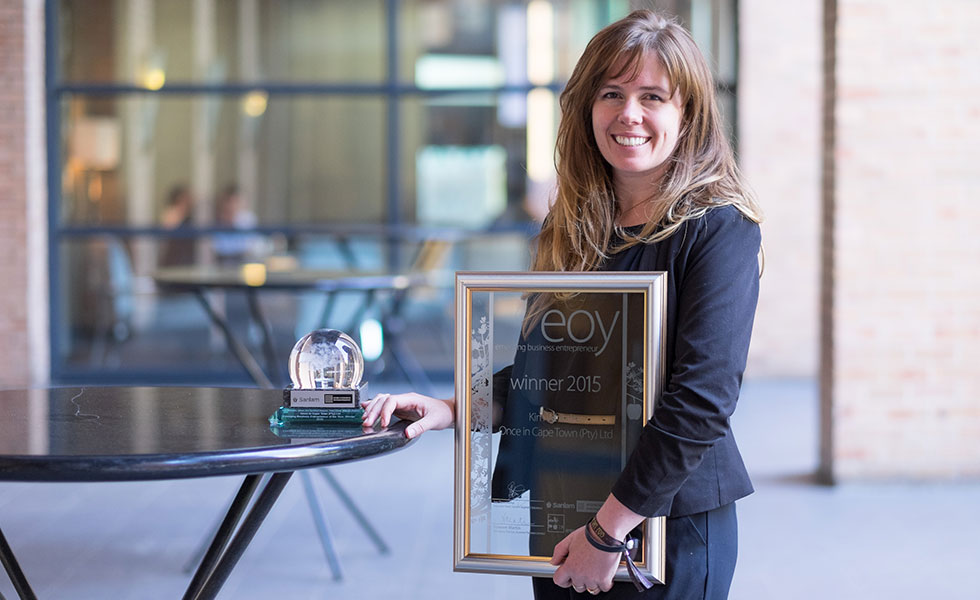
Past winner catch-up – where are they now?

2018 marks our 30th year in honouring entrepreneurs and the contributions they make toward growing the South African economy. We’re celebrating this milestone by catching up with some of the past winners of the competition.

Catching up with: Kim Whitaker

Winning year: Emerging Entrepreneur of the Year® – 2015

Winning business: Once in Cape Town is a combined product of two different accommodation types – a backpackers’ lodge and a luxury hotel – globally dubbed as a ‘poshtel’.

It’s been almost 3 years since you won the Emerging Entrepreneur of the Year® title in 2015, how has business been since then?

Business has been very good – we’ve grown year-on-year and even achieved some goals that we had set out back when we started our journey.

Shortly after winning the title in 2015, we were fortunate enough to realise one of our big dreams – expansion into Gauteng with “Once in Jo’Burg” in 2016. It has been incredibly exciting to watch the new branch grow from strength to strength.

Since the 2015 competition, I also became a parent and being a working-mom has now brought a few new challenges to my life – such as needing to travel and attend business meetings with my child (even to Germany for a trade show!).

Have you made any new developments within your business since winning?

We very recently launched a tourism academy for young women in the tourism industry. The academy will begin in May 2018 with 20 students initially – taking them through the basics of tourism management. We hope this will empower these young women to forge long and successful careers within the local tourism industry.

Eventually we hope to grow the academy to host up to 100 students per year. We want to be a driver of growth in our sector and contribute toward bolstering youth employment in our country.
We were also recently awarded our Fair Trade stamp after a thorough audit – achieving a 100% pass rate which we’re very proud of.

What was the biggest lesson you learnt from your stint in the EOY competition?

The competition was an eye-opener. Bearing witness to the innovative things others are doing reminded me to always put my best foot forward, and to be proud of our achievements.

The entire experience was exceptionally inspirational. I was able to meet and learn from so many like-minded entrepreneurs who have amazing businesses. In turn, this has led me to discover a personal passion for networking with other local entrepreneurs and for investigating the entrepreneurial landscape in South Africa. I am eager to be more involved in helping others discover their entrepreneurial talents and seeing how we, collectively, can grow our country.

What would your top piece of advice be for anyone looking to enter this year’s competition?

I think the biggest, and possibly the most important piece of advice I could offer other entrepreneurs looking to enter the competition would be to be themselves completely. Don’t be something you’re not – you should be proud of your business, and your uniqueness. Be proud to fit outside the box. Most importantly – know your business inside and out – and don’t be shy to show it off.

New Year, new flow

Cash flow management key to steering a clear course of business in 2018

A typical new year’s cliché is the commitment to resolutions – whether they be to start new healthy habits or break bad ones – something that is usually accompanied by the setting of new priorities for the year ahead. As much as this age-old tradition of self-improvement forms the basis for personal growth and success – for entrepreneurs, this sort of structured thinking is key to setting the tone for a productive year in business.

One of our competition judges, Kobus Engelbrecht of Sanlam / BUSINESS/PARTNERS says that for the year ahead, stringent cash flow policies should be top priority for entrepreneurs – especially where low economic growth forecasts paint a less than positive outlook.

“The successful management of cash flow, including the commitment to honouring debtors, creditors and payment deadlines, will play a vital role in determining the success of a business,” says Engelbrecht.

Engelbrecht lists the following tips for entrepreneurs looking to prioritise cash flow in 2018:

Spend time on forecasting – detail is key

Accurate forecasting is one of the best ways to ensure that your business stays on top of its finances over the next 12 months. When looking forward, it is important to first review historical financial statements in order to effectively predict potential dips in sales or increases in expenses.

Be real, and accurate

Though the temptation to be eternally optimistic is always present for entrepreneurs, it is more important that cash flow statements and forecasts are kept as real and accurate as possible. When income is overestimated, there is heightened risk because this can provide a false sense of security in the business. As such, figures should always be based on historical sales data – and any deviations should be derived from realistic and probable factors.

Regular updates

As a once-off review is not nearly enough to keep a tight hand on cash flow, entrepreneurs should review their business’ cash flow statements regularly. This will allow for the early detection of any potential problems that may arise.  

Get savvy with payments

Technology is an entrepreneur’s friend – often providing a range of solutions at minimal (or at least reasonable) cost. Why then, should payment systems be any different? Entrepreneurs should tap into technologies that will make life easier – both for the business and their customers. It is also recommended that clear payment terms be set out from the onset with customers and third party suppliers to ensure timely compensation.  

Plan for Plan B

While planning ahead and keeping a tight grip on cash flow throughout the year are both smart methods of business management, neither of these will be effective if there is no plan B in place for when trouble suddenly strikes. This is especially true in a volatile economy where the economic tide can shift without warning. It is a good idea, therefore, to have a blue-print plan to guide the business through any rough patches it may come across.

Stay on top of the game

The world is moving at an alarmingly fast rate and entrepreneurs would do well to keep up to date with trends and best practices, such as putting in place efficient cash flow forecast monitoring, monitoring the industry landscape and keeping an eye on interest rates.

Keep it simple

Budgeting and cash flow forecasts may appear complicated and overwhelming in the beginning, but they need not be. In some instances, a simple spreadsheet may be more than enough to effectively manage an annual budget. Regardless of whether the entrepreneur employs an accountant to draw up the financial statements, they should make a conscious effort to know exactly what these statements say and project, at all times.