How to create the best possible quotation

When a prospective client invites us to do a quotation we need to realise that this is when the tackie hits the tarmac. This is when our marketing and word-of-mouth endeavours materialise in tangible outcomes … or not. If we get this action wrong we have wasted the time, effort and money that got us to this point.

This article serves as a checklist of the elements and packaging of a quotation that will give us a fighting chance of winning a tender/job.

1. Pre-quote Analysis

  • When the prospective client makes the initial contact, it is good practice to get as much information as possible in order to understand the client’s need and also to prepare oneself to have all the “tools” available for doing an accurate quote.

2. On the day of the quote

  • Confirm the time and the address of the client.
  • Pitch up (we have to be there to be able to quote).
  • Be on time (or notify the prospective client if you are running late).
  • Be presentable (a neat/professional appearance).
  • Write down all specifications (leave nothing to chance).
  • Have client referrals and examples of previous projects available (e.g. printed referrals and pictures of other successful projects placed in a flip-file). Give this to the client to look through while you are busy gathering information for doing the quote.

3. After the specifications have been determined and before leaving the client`s premises

Confirm the delivery date of a written quote (confirm if this time frame meets the prospective client’s requirements).

4. Quote email

Present a great introduction including these elements:

  • Thank the client for the opportunity of quoting for the business.
  • Confirm the prospective client’s brief, i.e. what the client asked to be quoted on.
  • Edify (stories of satisfied clients).
  • Indicate when the service can be delivered.
  • Provide a link to your website (if you have one).

5. Quotation as email attachment

  • Detailed break-down (individual costing of parts/service elements, as well a labour cost component)
  • The validity period of the quote
  • Deposit needed to secure the job (also provide your banking information – name of bank, branch code of bank, your account name, your account number, the reference to be used)
  • Use a professional letterhead with your branding – if you have one.
  • Make sure the terms and conditions are included in the quote to be signed-off by the client when the quote is accepted.
  • Include a client satisfaction guarantee – money-back guarantee/free repairs if not 100% satisfied, or even something as simple as “We guarantee to be on time for the scheduled job and to leave your premises cleaner than we found it”.

6. Quotation reminder

Sent an SMS to the client immediately after the email with the quotation had been submitted.

Proposed wording of the SMS

Good day…  (name of client). I have e-mailed your quotation to ………… (email address) as promised. Kindly advise if you do not receive it, or have any further questions. We will contact you to follow up on the quote. I look forward to your expedient response and trust that we will be able to do business. Kind regards ……………… (your name and the name of your business)”

7. Quotation follow-up

Phone the prospective client to confirm that he or she had received the quotation, address any further questions and gauge the client’s decision to accept or decline the quote. If the quote is declined, see Point 8 for a script example to understand the main consideration for his or her decision.

8. To do after the response on the quote has been received

  • Signed quote :
    • Check if the deposit has been received (if not, address accordingly).
    • Confirm the implementation/delivery date and time with the client.
  • Quote declined
    • Phone the client to determine why you lost the business.
Here is a sample script to consider:

Good day…………… (name of client), this is …………… (your name and the name of your business).

Thank you for granting me the opportunity to quote for your business. I respect the fact that you have chosen another service provider. Would you kindly tell me what your main consideration was for choosing another service provider, so that I may address any shortcomings on my part for future application?

(Leave it open-ended – take notes)

Thank you for your feedback. I will take this knowledge on board. I trust that you will keep our information on record for future reference.

Have an excellent day. (Ring off)

9. Implementation

Always deliver more than you quoted for (e.g. deliver faster; upsize your service support; fix something else while you are there, without charging for it).

The task of your implementation is to “wow” and surprise the client – make it a memorable experience for your client.

10. After implementation

Always ask them to rate your service afterwards (compile a brief questionnaire and let one of your back office staff phone each client; record the feedback; apply what you have learnt; give recognition where deserved and reprimand and re-train when required).  Ask for referrals and introductions where positive feedback is received.

11. In closing

You can improve your success rate in turning quotes into business if you incorporate a quoting process which is both structured along the lines of this article and implemented in a professional manner.

Remember, getting the quote is important for the livelihood of the business and you.

May your business grow from strength to strength.

The key is to set realistic customer expectations and then not to just meet them, but to exceed them – preferably in unexpected and helpful ways.
Richard Branson

To support business owners with the important task of business planning, Sanlam gives you free access to the book Your Annual Business Game Plan for Success, which provides an easy and straightforward framework needed to draft a well-crafted game plan that will create the positive change and growth necessary for business success.

Go to www.sanlamgameplan.co.za to download your free copy.

Determined hospitality entrepreneur named Job Creator of the Year®

Having found a way to provide numerous employment opportunities to previously unemployed members from his immediate community in Pietermaritzburg, Siphiwe Ngcobo, founder of iLawu Hospitality Group, has been named Job Creator of the Year® at the Entrepreneur of the Year® competition sponsored by Sanlam and BUSINESS/PARTNERS awards ceremony held in Johannesburg on 6 September 2017.

They say failure is the best learning opportunity, and this is especially true for this year’s Job Creator of the Year®. With the shadow of a couple failed business attempts in his past – including that of a tech business, which saw him blacklisted as a result – Ngcobo persevered in his entrepreneurial pursuit for success, and today runs a thriving hospitality business.

Having originally founded a humble five bedroomed bed and breakfast in August 2009, the business has since expanded to become one of the most well-recognised hospitality and catering brands in KwaZulu-Natal, encompassing a guesthouse, an inn, a boutique hotel and studio apartments. The group has also recently launched a 4-star lodge in Newcastle and a food service division which is servicing corporate, government and leisure events across the region.

Ngcobo’s hospitality entrepreneurial journey started in 2005 when he initially took the decision to start investing in property within the Imbali township after seeing an opportunity to make favourable returns given the low property prices at the time. However, after identifying the demand for quality, yet affordable accommodation in the area due to the vast number of major annual sporting and cultural events being hosted, he shifted his focus from rental property to holiday accommodation and hospitality after he found a property he felt would work well as a bed and breakfast.

With no hospitality training or experience, Ngcobo was determined to lead his business into success. Learning everything he now knows through practical, hands-on experience, Ngcobo gave his everything to the business and ran every aspect on his own from housekeeping and reception to general management and sales and marketing.

This never-give-up attitude finally paid off, and today, iLawu Hospitality Group employs close to 100 people across a diverse portfolio of accommodation offerings that cater to many different markets, from corporate and government, to leisure groups looking for quality facilities with exceptional services, to locals looking to host elite events.

The competition judges believe Ngcobo’s passionate and enthusiastic leadership has resulted in the business’ exponential growth since its inception in 2009. “Ngcobo’s business has tapped into the rural market and has enabled him to offer employment to individuals who may otherwise have remained unemployed and unskilled due to the lack of opportunities available in these areas. Because of this contribution to driving job creation in the country, Ngcobo is a worthy recipient of the Job Creator of the Year® title.”

Please visit www.ilawugroup.co.za for more information on iLawu Hospitality Group.

Holistic funeral service provider named Medium Business Entrepreneur of the Year®

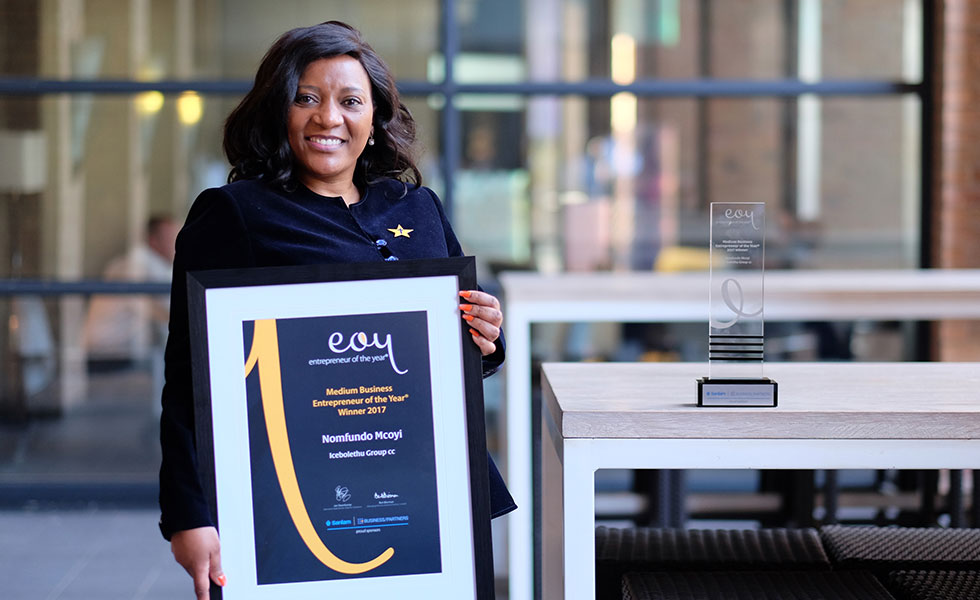
Nomfundo Mcoyi, ex-educator and now managing director of KwaZulu-Natal-based business – Icebolethu Group – was named the Medium Business Entrepreneur of the Year® at the annual entrepreneur of the Year® competition sponsored by Sanlam and BUSINESS/PARTNERS awards ceremony, held on 6 September 2017 in Johannesburg.

Established as a funeral parlour named Icebolethu Funerals in 2009, with a complement of just five staff members, the business has evolved into a prominent funeral services conglomerate with around 300 employees. 

Today, the company consists of seven divisions offering an all-encompassing funeral service operating under the umbrella of Icebolethu Group and boasting 43 branches in and around KwaZulu-Natal, as well as a branch in the United Kingdom and Zimbabwe.

Considering that the funeral business is a highly competitive industry, especially in the South African small and medium enterprise (SME) sector, Mcoyi stood out to the competition’s judging panel by managing to yield tremendous growth for her business by capitalising on the already ripe market and providing a customer-centric service, while still demonstrating dignity and care to her community. “Mcoyi truly understands the market and their needs, and this has provided her with a competitive advantage over many other small firms in the industry,” the judges add.

Discussing why she believes her business is worthy of this prestigious award, Mcoyi recalls her humble beginnings after taking the decision to quit her job as an educator and start her catering business, only to be left with nothing following her divorce in 2009. In order to provide for her children, she then started a small funeral parlour based in the township of Hammersdale, KwaZulu-Natal.

In less than a decade, she has grown this one small parlour into the network it is today. “This was done by offering more than just a funeral policy to our clients,” explains Mcoyi. “Unlike most other providers in the country, we grew Icebolethu Funerals into a one-stop-shop offering clients everything from funeral services, to catering and tombstones.”

Mcoyi also attributes her business’ success to its rigorous marketing and advertising strategy that is designed to tap in to the needs of the community. “Our unique branding, combined with consistently providing an excellent service offering, has resulted in us capturing a large portion of a highly competitive South African market,” Mcoyi added.

When asked about her future plans following winning the 2017 Medium Business Entrepreneur of the Year® title, Mcoyi says that she plans to expand her business further throughout South Africa, starting with Cape Town.

For more information on Icebolethu Group, please visit the website: icebolethugroup.co.za

Four steps to create an inclusive work environment for your business

Business owners are lucky that they create their own work environment, unlike managers in large corporations who step into rigid, pre-created cultures. However, many business owners allow the working culture in their businesses to flow organically from their personality, without giving much thought to how it could be perhaps better engineered.

Kgomotso Ramoenyane, executive general manager: human resources at Business Partners Limited (BUSINESS/PARTNERS), believes that there is a lot to be said for consciously shaping the work environment in a business rather than leaving it up to chance, and specifically to aim towards creating an inclusive culture.

Inclusivity in a business means that the staff members feel valued and free to express who they are, where workers are keen to contribute not merely their contractually required output, but any of their ideas, knowledge and support that can help build the business. In an inclusive environment conflict is not shunned or suppressed, but channelled in such a way that everyone is keen to debate, participate and resolve, even if their ideas do not always hold sway.

Ramoenyane says inclusivity is not the same concept as diversity, although the two are closely linked. Almost always, diversity provides a force that steers an organisation in the direction of inclusivity because different kinds of people – young and old, male and female, black and white, local and foreign – are thrown together in one space and naturally seek to find harmony with each other.

But although diversity can often lead to inclusiveness, inclusivity is more than just diversity. It is quite possible, for example, for a diverse organisation to develop an oppressive atmosphere when management fails to make staff feel valued and included.

Why is inclusivity good for business? Can’t a regimented business where everyone does exactly as they are told also be a highly efficient organisation? Perhaps, but it is also a rigid organisation that is highly fragile in an ever-changing environment, says Ramoenyane. Inclusivity helps a business to adapt easily to changes in the market.

Her list of advantages of an inclusive business culture include higher productivity and lower staff turnover because workers feel valued, solutions to problems are found and implemented quickly because everyone feels free to contribute, innovation thrives because the development of products, services and systems are the result of inputs from many people, the knowledge base of the business expands, making it easier for the business to adapt to changes and ultimately enter and conquer new markets.

Ramoenyane acknowledges that creating an inclusive work culture can be difficult for owner-managers, many of whom characteristically have strong beliefs about how things should be done. Often, they are more used to being listened to than to listen. Another problem is that creating a workplace culture is intangible, abstract and all but impossible to measure. Given all the practical problems that business owners have to contend with, it is not surprising that something like the culture of the workplace is ignored as a fuzzy and less important issue.

Yet the results of an inclusive workplace culture is anything but fuzzy. Those very practical problems that tend to keep business owners preoccupied at the expense of working on their workplace culture can be solved so much easier if the whole workforce is fully engaged in the business.

Ramoenyane offers four steps that business owners can take toward creating a more inclusive business:

1. Define your business goals

If the business owner does not have a clear direction and vision for the business, chances are that the employees’ involvement in the workplace will not go beyond an I-just-work-here attitude. The vision for a business can go beyond growth in turnover and profitability and can include values and ethos. Having inclusivity expressed as part of your vision will of course help towards creating an inclusive work environment.

2. Share your vision with your staff

Whether it is in a series of workshops, discussions, memos or day-to-day interactions with your staff members, explain and engage constantly with them about your business goals. Invite comments and suggestions on how to make your vision a reality, and be genuinely open to their ideas. Employees who buy into your vision are much more likely to feel at home and included in your business.

3. Strive for diversity

With every new staff appointment that you make, you have the chance to increase the diversity of your company. The case for purposefully striving for diversity in your workforce is strong: it can enhance creativity and innovation, it can help to open up new markets and to increase productivity and profitability.

4. Give – and take – feedback

Don’t tell valuable employees for the first time just how valuable they are when they hand you their notice of resignation. By then it is much too late. Giving praise and corrective advice is an art which every business owner should refine and practice as a habit. But it is just as important to remember that feedback is a two-way communication. Business owners must learn to listen as much as they must learn to give feedback. If you can do both with genuine empathy, everyone in your business will feel at home. 

Work on and not in your business

You have surely heard the statement above, but what does it really mean?

To start, run and succeed in business is not for the faint-hearted. Why? International statistics state that 40% of all new business start-ups fail in the first year and 80% within the first 5 years, and 80% of those who made it through the first 5 years fail in the second 5 years. Hence, only 4% make it after 10 years. South Africa is no different – our failure rates might even be worse. It is said that business is simple, but not easy.

Where do you find your business on this bumpy road to success?

In the classic entrepreneurial book, The E-Myth, Michael E. Gerber unveils the reality of running and owning a business.

A business owner, according to him, is 3 people in one:

  • An Entrepreneur : visionary, innovator, is mostly unstructured, deal-maker
  • The Manager: practical, planner, implementer, creator of order from chaos
  • The Technician: the doer

Many people start their own business, because they are good technicians, but without prior knowledge and experience of running a business.

This article provides some insights into how the business owner can juggle the three roles (entrepreneur, manager and technician) to enable a business to grow and become more successful over time.

Practical guideline to illustrate how a business owner can work ON his/her business

Element Task Role Where to get help

Business Owner– self

Improve own skills – continuous education

Technician

Industry training bodies / Technicon / University


Decide which tasks / responsibilities may be delegated

Technician / Manager

Management team


Redefine own responsibilities after the task above is done

Manager


Focus on:

  • Deals
  • Innovation
  • Financial well-being of business
  • Competitiveness of business


Entrepreneur
Technician
Manager

Manager


Sales staff
Specialists in industry
Accountant

Accountant

People management

Create job descriptions

Manager

HR practitioner


Negotiate key performance areas with staff

Manager

HR Practitioner


Address remuneration and incentives for staff

Manager

HR Practitioner


Upskill staff

Technician

Industry training bodies

Marketing

Choose the optimal marketing elements to market the business

Manager

Marketing Specialist


Identify the target market

Manager

Marketing Specialist


Do research – competitors and trends in industry

Technician/Entrepreneur

Press releases /
website of competitors / market research specialist

Sales

Ensure optimal staff appointment practices

Manager

Staff placement agency

Sales (continue)

Identify the ratios and figures which will present guidance on how well the business is doing w.r.t.:

  • Prospecting new clients
  • Number of quotes
  • Number of accepted quotes
  • Number of implementations
  • How well after-sales service is done
  • Number of sales to existing customers

Manager/Entrepreneur

Sales Specialist

Information Technology

Is the business using technology productively?

Manager

IT Specialist

Management

Does the business comply with all appropriate legislation

Manager

Accountant


Are management meetings scheduled and structured?

Manager

Management team


Are minutes of meetings and decisions taken up to date?

Manager

Management team


Are the financial reports up to date?

  • Dashboard
  • Projections vs. actual figures
  • Corrective actions where targets are not being achieved

Manager

Accountant

In closing

The reality of the practical guideline above is that the majority of tasks to be done in business speaks to the role of manager. The implication is that, if you are doing all the work as technician (the doer), the progress and future success of your business will suffer.

This list of tasks is by no means complete, but it is a very good point of departure. It is very important that you find the balance between the roles of Technician, Manager and Entrepreneur that will work best for you and your business.

To support business owners with the important task of business planning, Sanlam gives you free access to the book Your Annual Business Game Plan for Success, which provides an easy and straightforward framework needed to draft a well-crafted game plan that will create the positive change and growth necessary for business success.

Go to www.sanlamgameplan.co.za to download your free copy.
SME success a by-product of growth

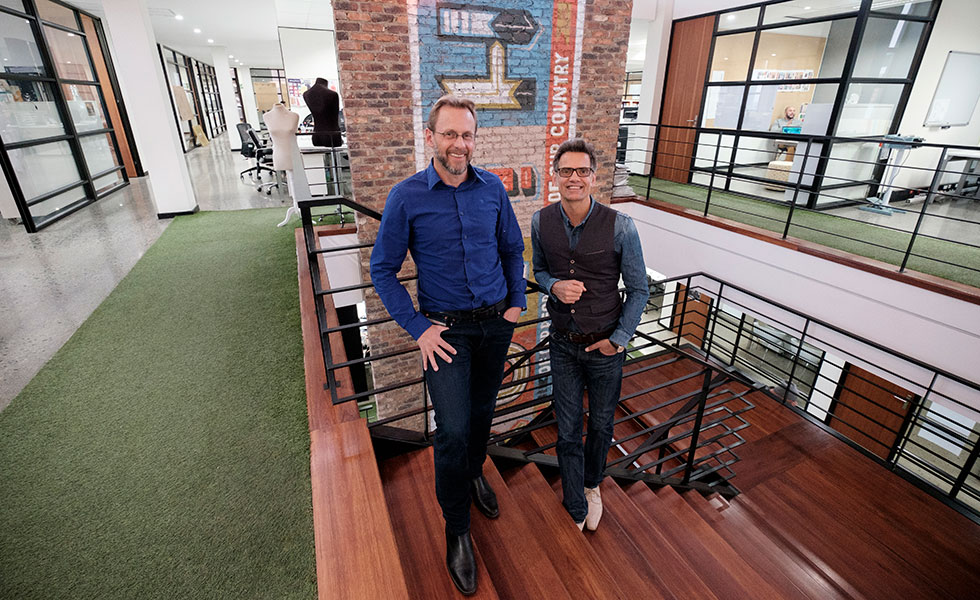
When Pepe Marais and Gareth Leck founded Joe Public in March 1998 in Cape Town, they disrupted the local advertising industry with their innovative business model which was positioned as a Take-Away menu -aimed to demystify the business of advertising by making its service offering transparent to clients.

“We started the business without a cent to our names and grew it through innovation, not only in terms of our business model, but with our creative offering to our clients,” says Marais. “Our unique selling point was that our advertising services for print, TV and radio were categorised as rare, medium and well done and were displayed on a menu,” he explains.

In order to expand their concept, the duo sold their business to IPG, an international marketing network in 2001, and by 2006 had expanded Joe Public to a second office in Johannesburg. It was however not all smooth sailing – it was during 2006 that the business lost its biggest client, resulting in retrenchments due to loss of revenue. “At that stage, we realised that working under the corporate whip of an international giant was counter-productive to our culture and entrepreneurial spirit,” says Marais.

Following this realisation, after three years of negotiations, and amidst a global recession which had detrimental effects on the South African economy, the pair bought back their company and started to rebuild it from the ground up – with depleted cash reserves and a headcount of 30 staff.

“Just as we were getting on our feet again our biggest client slashed their marketing budget to 0%. Because we were trying to rebuild our business, we made the decision to work for free for the next seven months. During this period we also managed to win six new clients,” adds Leck.

To this day, Joe Public is ranked as one of the largest independent, 100% South African owned brand & communications group in the country, offering full services in advertising and communications through five integrated specialist companies: Joe Public (Above-the-line), Connect Joe Public (Digital), Engage Joe Public (Public Relations), Ignite Joe Public (Cross-platform) and Shift Joe Public (Brand Design).

Marais says that through their experience of starting a small business, securing a merger, buying back the company, and then going bankrupt and starting from scratch again, they have developed their management and leadership skills based on their resilient entrepreneurial characteristics.

“Once we regained ownership of our business, it forced us to do some soul searching which resulted in the realisation that the purpose of our business was growth – in terms of bolstering the growth of our clients through advertising, the personal growth of our staff and in turn contributing to the growth of our country,” explains Marais.
“In light of this, we also started our own non-profit organisation in 2008 called One School At A Time and have recently registered our own development academy, Joe Public School of Growth,” continues Marais. “We are passionate about assisting small business owners in growing their businesses and have run 18 workshops to help these individuals define the purpose of their businesses over the past few years.”

Joe Public prides themselves as a people driven organisation and although they are a high energy and competitive meritocracy, they strive to remain courageous, firm, passionate and compassionate at all times.

Pepe Marias and Gareth Leck are finalists in the 2017 Entrepreneur of the Year® competition sponsored by Sanlam and BUSINESS/PARTNERS. For more information on their business, please visit the Joe Public website: joepublic.co.za.

Innovative entrepreneur taking the local ICT sector by storm

100% black female owned company – Mighty Comms – is a broadband solutions company that has carved out a niche for itself in the South African ICT sector. The company offers clients across various sectors broadband and network design services, deployments, installations and maintenance services.

Mighty Comms founder, Refilwe Marumo, says she has encountered many twists and turns during her entrepreneurial journey. “My first business venture was a corporate cleaning business established in 2005 named Mighty Care, which traded for about three or four years. This was followed by a period of broadcasting service applications with a consortium, but after two rounds of applications, we were still not successful and the business had to evolve in order to survive.

“In 2014, we underwent a name change, from Mighty Care to Mighty Comms, and armed with a new vision we focused on the ICT industry, and offered a selection of products that we had experience in. With a staff complement of only four, we started small and the growth has since been organic.”

Today, Mighty Comms employs 10 people, the bulk of which are female technicians and ICT specialists. “We broadened our scope to deployments in 2016, which meant a greater focus on Core Network designs, LAN installations and maintenance, which led to the additional job creation for six technicians. We are passionate about empowering women in the ICT sector and have upskilled all new employees through various courses offered to the ICT industry.

Having recently embarked on machine monitoring innovation with our partner IoT NxT, Marumo says that further employment will be created over the coming year. “Machine monitoring innovation is truly the cutting edge of the Internet of Things (IoT), where analogue equipment is ‘transformed’ into digital, for easier monitoring and asset tracing.

“We believe we are at the crux of the future and in order to scale accordingly, are taking in 20 new learners, who will receive the necessary ICT industry training and exposure. The idea is that some of these learners will be employed by Mighty Comms on a full-time basis in the future,” she explains.

Accredited with global original equipment manufacturers (OEMs) such as Alcatel Lucent, Huawei and Ruckus, and boasting an impressive list of Government and private clients, Mighty Comms seems set for great things. “The business has shown significant growth in the past year, increasing revenue by a whopping 147%,” says Marumo. “We have also been approached by three multinational companies in the past year – one that offers hospital management solutions and another that supplies two-way radio trunking products and a swift messaging platform for the banking sector – to be their local partner.

“These partnerships have led to an even greater focus on the upskilling and training of our employees, as our technicians will need to learn the ropes on how we can take these new products to market,” she concludes.

Refilwe Marumo is a finalist in the 2017 Entrepreneur of the Year® competition sponsored by Sanlam and BUSINESS/PARTNERS. For more information on her business, please visit the Mighty Comms website: mightycomms.co.za.

Independent research firm carves a niche in the investment industry

After having worked as an Investment Analyst for large institutions for 12 years, Shamil Ismail – who was voted the 2014 ABSIP (Association of Black Securities and Investment Professionals) Analyst of the Year – founded Primaresearch in late 2015 as an independent, sell-side, equity research firm based in Cape Town. Since then, Primaresearch has grown to six analysts, and developed a reputation for crafting innovative and insightful research which combines traditional fundamental analysis with industry insights. Primaresearch was voted First in the Innovative Research category of the 2017 Financial Mail Analyst Rankings.

Offering some insight from inside the industry, Ismail explains that the investment sector can be broadly split into two parts – the “buy side” (fund managers) and the “sell side” (stockbrokers). “In recent years, the stockbroking sector has faced multiple challenges, including margin compression, growth in a low-touch, low commission, and more stringent regulations which will ultimately split research and dealing costs.”

Added to these challenges, Ismail says there is growing pressure on South African fund managers to increase their brokerage allocations to black-owned stock broking firms. “So while revenue for the overall brokerage market is under pressure, there is a segment of the market that is growing – the black-owned stockbroker segment.

“There are only a handful of black-owned stock broking firms in South Africa and not all of these brokers have a strong research product offering at present. This is the opportunity that Primaresearch has tapped into: To provide high-quality, niche research by a firm that is owned and majority staffed by black analysts.”

Ismail adds that the business focuses its research on consumer-facing companies. “We have developed a reputation as the ‘go-to’ specialists in the niche of consumer companies and, over the past 18 months, have built a formidable client base which includes all the major asset managers in South Africa, as well as four foreign fund managers.”

In a short space of time, Primaresearch has managed to redefine what sell-side investment research could be. “We have identified a niche, and tapped into the opportunity, with plans in place to grow further in the future. These plans include the launch of ‘PrimaPlatform’, which allows independent analysts to plug into our portal, and service the investment community.”

Shamil Ismail is a finalist in the 2017 Entrepreneur of the Year® competition sponsored by Sanlam and BUSINESS/PARTNERS. For more information on his business, please visit the Primaresearch website: primaresearch.co.za.

The local entrepreneur enhancing the fashionista in plus-size women

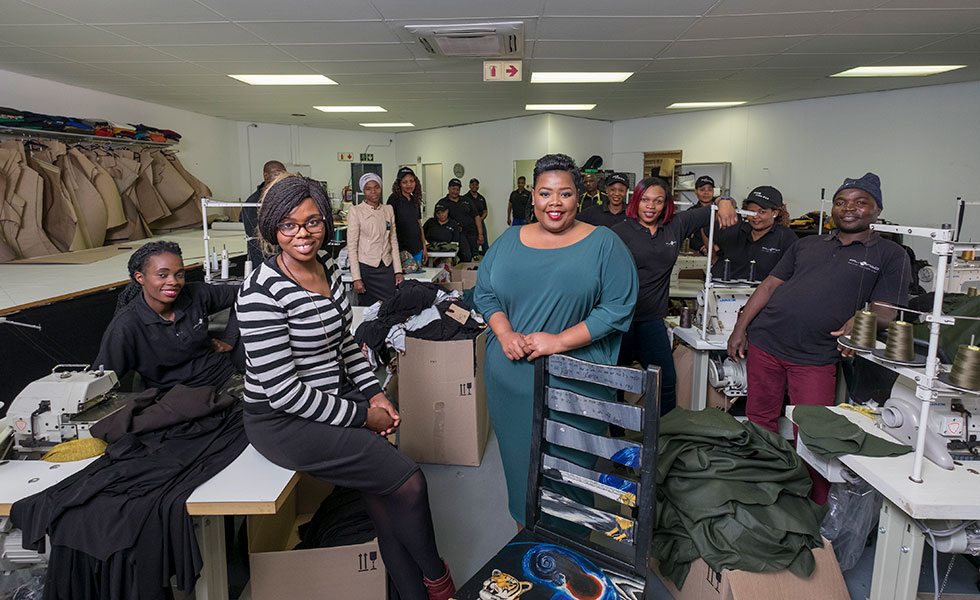
Incessantly frustrated by the limited range of fashion available to the fuller-figured woman, Limpopo-born and Pretoria-based Ouma Tema began designing and creating her own clothes and sharing images of her creations on social media. After fielding a continuous stream of questions from friends and fellow plus-size ladies around where she purchased her outfits, Tema knew she had tapped into a gap in the market and launched her own fashion brand targeting plus-size women.

After starting out in Tema’s garage six years ago, Plus-Fab is today a fully-fledged production factory employing 16 people. It is one of the most sought-after designers for plus-size women in South Africa and neighbouring African countries, distributing and selling through fast-growing retail chain – The Space.

Tema says that social media has played a major role in the business’ growth and success over the years. “In order to ensure a marketing strategy is successful, you need to know who your clients are and where to find them. It is also essential to be able to communicate with this client base in their home language. Our marketing strategy is very much rooted in social media because we know that this is the best way to reach our target market.”  

Although known for its timeless patterns, Tema makes certain that the Plus-Fab range is not only timeless and comfortable, but also fun and confidence boosting. “We create a range of clothing that embraces, as opposed to covering up curves. Each outfit should be a statement while still maintaining a timeless sense of style and flair.

She says that she was inspired by the stories of iconic South African women such as Saartjie Baartman. “These women were shunned and even ostracized because their physical stature did not conform to the ‘norm’. Geared towards the fashion savvy, modern day plus-size woman who is looking for plus-size fashion that not only fits but accentuate her curves, Plus-Fab is focussed on dispelling the notion that plus-size women should not look fabulous and sexy.”

As Plus-Fab continues to take the South African plus-size fashion for women industry by storm, Tema is excited about the future prospects of the business. “We currently stock 10 stores across the country, covering Gauteng, KwaZulu-Natal, the Western Cape and the Eastern Cape, and are always looking for opportunities to grow Plus-Fab’s footprint, both in South Africa and abroad. The most recent development in this respect has been the opening of our online store to neighbouring countries.”

Ouma Tema is a finalist in the 2017 Entrepreneur of the Year® competition sponsored by Sanlam and BUSINESS/PARTNERS. For more information on her business, please visit the Plus-Fab website: plus-fab.com

Finding the gap in an established market

Dirk Coetzee and Associates was born out of the growing need for taxation services specifically catering to the fiduciary industry. About two and a half years ago, when the Tax Administration Act was signed into law and tax services to a deceased estate could thereafter be loaded as a separate claim against the estate, the executor’s office did not have the capacity, time or know-how to deal with the growing fiduciary demand. Lifelong friends, Merwe Moelich and Dirk Coetzee, saw the gap in the market that the legislative change had created and jumped on it, establishing a company in 2014 that specialises in deceased estates, trusts and high net worth individuals.

“About 90% of our clients are from the fiduciary industry, made up of two of South Africa’s big four banks, as well as attorneys on the service provider panels of these banks. The other 10 % is made up of small business clients and individual income tax clients,” says Moelich.

Currently, Dirk Coetzee and Associates is the only tax service provider of its kind in South Africa to have successfully negotiated and established the most weekly appointments with all the South African Revenue Service (SARS) branches in the Western Cape to attend to their clients’ tax matters.

Moelich explains that a normal tax practitioner gets on average a one hour appointment per month at SARS, in which a maximum of 10 cases could be handled. “It was a major challenge to convince SARS that our business could simply not be classified as normal tax practitioners, because we handle such a high volume of cases, and on behalf of corporate executors. After tireless negotiations with the Western Cape Government and SARS for more set appointments, we are now able to handle approximately 400 cases per month. We are also in the process of arranging additional appointments in other provinces to meet the growing demand and workload.

To have found a niche market in the tax services industry is something very rare, says Coetzee. “The core of our work consists of the submission of income tax returns for deceased estates and trusts. All of our systems are implemented to align with the Standard Operating Procedure of SARS. We are also members of The Fiduciary Institute of South Africa (FISA), which helps us to stay abreast of any developments in this industry.

“Any changes to these procedures are communicated to us immediately, and our systems adjusted accordingly,” he adds.

With regards to their marketing and sales recipe, Moelich and Coetzee believe that actions speak louder than words. “From the start, it was established that in our field, the most effective marketing tool would be our service delivery, which includes quick feedback and frequent reporting to our clients. We identified that the administrators from the fiduciary industry were getting little or no feedback on their instructions from their current service providers, and we therefore made it our mission to provide frequent feedback, and reply to any queries within 24 hours.

“We would start with a certain branch of a trust company or attorney, prove ourselves, and then later approach further branches to offer our services. This strategy has proved successful and almost all the growth experienced has been due to positive word of mouth from current clients.”

Merwe Moelich and Dirk Coetzee are finalists in the 2017 Entrepreneur of the Year® competition sponsored by Sanlam and BUSINESS/PARTNERS. For more information on their business, please visit the Dirk Coetzee and Associates website: www.dcoetzee.co.za.